Quick verdict
Making your own dog treats is one of the easiest wins in dog care: three or four everyday ingredients, twenty minutes in the kitchen, and you know exactly what your dog is eating. For most healthy dogs, a simple homemade biscuit beats a mystery-ingredient treat from a discount bin every time. The catch is that "homemade" is not automatically safe — a handful of common kitchen ingredients are toxic to dogs, and a well-meaning recipe copied from a random blog can include one of them. Start with the short list of proven-safe ingredients below, follow the three beginner recipes, and keep portions small. If your dog has allergies, pancreatitis, or any condition that limits fat or protein, check with your vet before you start experimenting.
Why bother making treats at home?
Shop-bought treats are not all bad, but their labels can be hard to read honestly: long ingredient lists, vague terms like "meat derivatives" or "flavourings", and serving sizes that quietly add up to a large share of your dog's daily calories. When you bake at home, the label is the recipe — oats, pumpkin, peanut butter, banana — and there is nothing to decode.
Homemade treats are also the cheapest way to solve two everyday problems. First, training: small, soft, smelly treats are far more motivating than dry kibble, and a batch of pea-sized bites costs almost nothing. Our treat pouch guide covers how to carry them without ending up with crumbs in every pocket. Second, enrichment: a smear of pumpkin and yoghurt on a lick mat, or a stuffed and frozen toy, can keep a restless dog busy for twenty minutes while you take a work call — our puzzle toys for beginners guide explains how to use treats as part of that rotation.
None of this needs to be a project. The recipes below use one bowl, a baking tray, and ingredients you probably already have. If you can make porridge, you can make dog treats.
The ingredients to never use
This is the one section to read before you touch a mixing bowl. Several foods that are harmless — even healthy — for humans are dangerous for dogs, and some of them show up in human baking all the time.
Xylitol (birch sugar). The most dangerous item on this list. It is a sweetener found in some sugar-free peanut butters, sugar-free gum, and low-sugar baked goods, and even a small amount can cause a dangerous drop in a dog's blood sugar and liver damage. Always read the peanut butter label: the ingredients should be peanuts and, at most, salt. If you see xylitol, birch sugar, or any sugar alcohol, do not use it.
Chocolate, cocoa, and coffee. Theobromine and caffeine are toxic to dogs, and the darker the chocolate, the worse it is. This rules out any recipe borrowed from human baking — no cocoa powder, no chocolate chips, no coffee flavouring.
Grapes and raisins. A small number can cause kidney failure in some dogs, and nobody can predict which dogs are sensitive. Leave them out entirely, including in trail-mix-style recipes.
Onions, garlic, chives, and leeks. All members of the allium family damage dogs' red blood cells. Garlic powder is a common seasoning in human recipes; keep it out of the dog's batch, even in small amounts.
Macadamia nuts. Toxic to dogs even in small quantities, causing weakness and tremors. Other nuts are not toxic in the same way, but they are high in fat and a choking risk, so skip nuts altogether.
Raw yeast dough and alcohol. Raw dough can rise in a warm stomach and produce alcohol as it ferments. Never let your dog near dough that is still proving.
Cooked bones and corn cobs. Not ingredients in a recipe, but worth stating: cooked bones splinter, and corn cobs are a classic blockage. Neither belongs in a treat.
If a recipe you find online contains any of these — or anything you cannot identify — skip it. There are plenty of safe recipes; there is no reason to gamble on a questionable one.
The safe starter pantry
You need very little to start. These are the ingredients used in the recipes below, and each one is widely accepted as dog-safe in normal amounts:
- Rolled oats or oat flour. The backbone of most dog biscuits: cheap, gentle on digestion, and easy to grind into flour in a blender.
- Pumpkin purée (plain, unsweetened). Not pumpkin pie filling, which is spiced and sweetened. Plain purée adds fibre and moisture and most dogs love the taste.
- Peanut butter (xylitol-free). Check the label, as above. Natural peanut butter with just peanuts is ideal.
- Banana. Sweet enough to make treats appealing, soft enough to mash with a fork.
- Sweet potato. Cooked and mashed, it binds a dough well and adds fibre.
- Carrots and blueberries. Good mix-ins for crunch and colour, and handy as low-calorie training rewards on their own.
- Plain yoghurt. Useful for frozen treats; choose unsweetened, and skip it if your dog is lactose-sensitive — many dogs tolerate small amounts fine, some do not.
One caution about "safe" lists: safe does not mean unlimited. Treats are extras, and a dog with a sensitive stomach can still react to a new food, even a safe one. Introduce one new ingredient at a time and watch the stool for a day, just as you would when changing kibble.
Three beginner recipes
Each recipe makes roughly 25–30 small treats and takes under 30 minutes including baking time. Roll the dough into pea-sized balls and flatten them with a fork — smaller is better for training.
1. Peanut butter and banana bites (no bake)
Mash one ripe banana, stir in three tablespoons of peanut butter and one tablespoon of rolled oats, then roll into small balls and chill in the fridge for an hour. These are soft, smelly, and perfect for training, but they are also perishable — fridge only, and use within three days. Because they are soft, they are a good first recipe for puppies and older dogs with worn teeth.
2. Pumpkin and oat biscuits (baked)
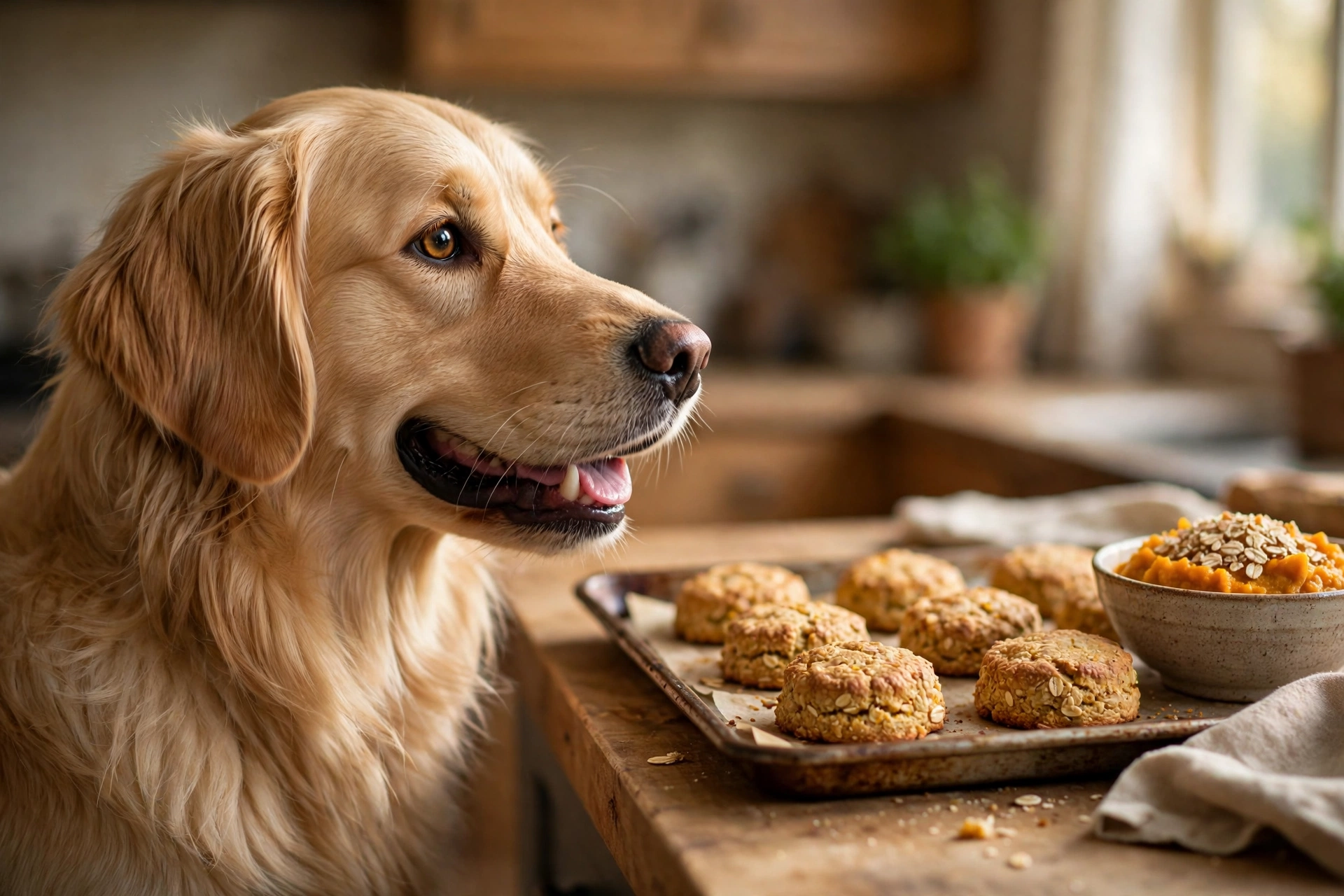
Mix one cup of plain pumpkin purée with two cups of oat flour and one egg until a firm dough forms. Roll it out to about half a centimetre thick, cut into shapes, and bake at 175°C (350°F) for 20–25 minutes until firm and lightly golden. Let them cool completely before serving. These are the workhorse biscuit: dry, crunchy, and the easiest to store — the storage section below explains how to keep them fresh.
3. Frozen yoghurt and blueberry bites
Spoon plain yoghurt into a silicone ice-cube tray, drop two or three blueberries into each compartment, and freeze for at least four hours. These are ideal on hot days, and freezing turns a spoonful of yoghurt into a five-minute activity instead of a five-second lick. If your dog is new to yoghurt, start with one bite and check that the stomach is happy before offering more.
Portions: the 10% rule
The most common mistake with homemade treats is not the recipe — it is the quantity. A useful rule, widely recommended by vets, is that treats should make up no more than 10% of your dog's daily calories. For a small dog, that can be as little as two or three small biscuits a day; for a large dog, a small handful.
Three habits make the rule easy to follow. Make them small. A treat the size of your thumbnail is enough for a reward — dogs grade treats by smell, not size. Count them. Put the day's treats in a small container in the morning and stop when it is empty. Subtract from meals. If you have done a big training session, take a spoonful of kibble out of dinner to balance it.
Storage: what keeps, and for how long
Homemade treats have no preservatives, so they go off faster than shop-bought ones — but with the right storage they still last well.
Dry baked biscuits keep for one to two weeks in an airtight container at room temperature, away from sunlight. If you want them to last longer, bake them a few minutes extra until they are properly dry — moisture is what invites mould. Our food storage containers guide covers airtight options that work just as well for treats as for kibble.
Soft or no-bake treats belong in the fridge and last three to five days. Anything with fresh banana, yoghurt, or meat should be treated like leftovers, because that is what it is.
Freezer is your best friend. Almost any homemade treat freezes well for up to three months in a sealed bag or container. Bake a double batch, freeze half in weekly portions, and thaw what you need overnight in the fridge. Frozen treats also double as enrichment: a frozen stuffed toy or a frozen yoghurt bite takes far longer to finish than the same thing at room temperature.
Tools that make it easier
You do not need special equipment, but three things genuinely help once homemade treats become a habit: a lick mat for spreading soft mixtures, a sturdy stuffable toy you can fill and freeze, and a proper airtight container so the batch you baked on Sunday is still good on Friday.
LickiMat Classic by LickiMat
Best for: Anxious eaters, Dogs that need mental stimulation at meals
- Textured surface for spreading soft foods per manufacturer specs
- Made from food-grade TPR
- Freezer and microwave friendly per manufacturer
What we like
- Turns meals into a calming licking activity
- Great vehicle for peanut butter, yogurt, pumpkin
- Easy to rinse clean
Tradeoffs
- Not a chew toy — supervise and remove when empty
- Thin surface can be punctured by determined chewers
Based on published specifications · Last checked 10/08/2026
KONG Classic by KONG
Best for: Stuffing, freezing, and fetch
- Natural red rubber formula per manufacturer specs
- Hollow center for stuffing
- Vet-recommended design per brand claim
What we like
- Endlessly stuffable — kibble, peanut butter, frozen mixes
- Bounces unpredictably for fetch
- Dishwasher safe
Tradeoffs
- Black 'extreme' version needed for power chewers
- Rubber smell when new (fades)
Based on published specifications · Last checked 10/08/2026
IRIS USA Airtight Pet Food Container by IRIS USA
Best for: Owners buying standard-size kibble bags, Kitchens that need a tidy, sealed pantry solution
- Airtight snap-lock lid with foam gasket, per manufacturer specs
- BPA-free, food-grade plastic construction
- Slim profile designed to fit narrow pantry spaces
- Matching scoop included, per manufacturer
What we like
- Genuine airtight seal keeps kibble fresher longer
- Wide mouth makes scooping and cleaning easy
- Slim, stackable design saves pantry space
Tradeoffs
- Large-bag owners may need two containers
- Plastic can retain odors over time if not washed between bags
Based on published specifications · Last checked 10/08/2026
When to ask the vet first
Homemade treats are safe for most healthy dogs, but check with your vet first if your dog has food allergies, pancreatitis or any condition that limits fat, kidney disease, diabetes, or a history of stomach sensitivity. Puppies under four months and dogs on a prescription diet should also stick to what the vet has approved. And if your dog ever eats something from the never-use list above, call your vet or an animal poison helpline immediately rather than waiting to see what happens — with xylitol and chocolate, early treatment matters. If your dog has had digestive trouble before, our probiotics guide explains when gut support is genuinely useful and when it is a waste of money.
FAQ
Can I use regular flour instead of oat flour?
Yes. Plain wheat flour works in the baked biscuit recipe, but oat flour is gentler on sensitive stomachs and adds a little fibre. If your dog has a known wheat sensitivity, stick with oats or try rice flour.
My dog won't eat the treats. What went wrong?
Probably the smell, not the recipe. Dogs choose food mostly by scent, so a bland biscuit can be ignored even when it is perfectly edible. Try the no-bake peanut butter bites, which are much smellier, or warm a baked biscuit for a few seconds to release the aroma. If your dog turns down every homemade option, use a small piece of their normal food as the training reward instead — the treat is a tool, not a test.
The bottom line
Homemade dog treats are simple, cheap, and genuinely better than most shop-bought options — as long as you respect the short danger list and keep portions small. Start with one recipe, use ingredients you already trust, store the batch properly, and let your dog's reaction tell you whether to make it again. The goal is not a bakery: it is a jar of treats you made yourself, with nothing in it you would not want your dog to eat.
More in Feeding & Treats
Probiotics for Dogs: When They Actually Help (and When They're a Waste)
Probiotics help dogs in a few specific situations — post-antibiotics, abrupt diet changes, travel stress — and waste money outside them. Formats compared, label red flags, and when it's a vet visit instead.
Pet Water Fountains: Encouraging Healthy Hydration
Moving, filtered water stays fresher and draws dogs to drink more. We cover how fountains work, the maintenance they demand, and which materials hold up best.
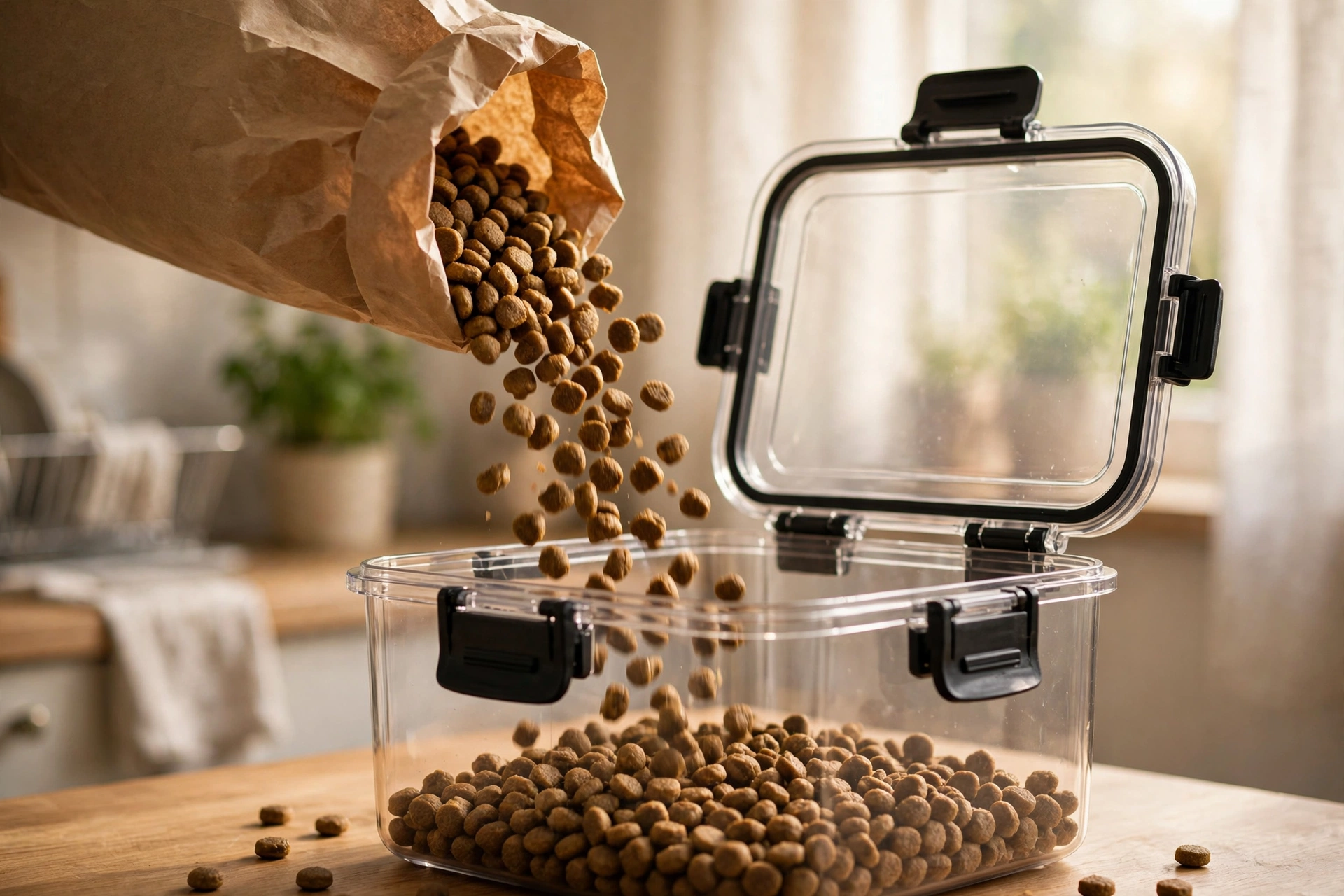
Dog Food Storage Containers: Keeping Kibble Fresh for Weeks
Kibble starts going stale the moment the bag opens. Here's how airtight containers work, what makes a seal actually airtight, and how to size one to the bag you buy.