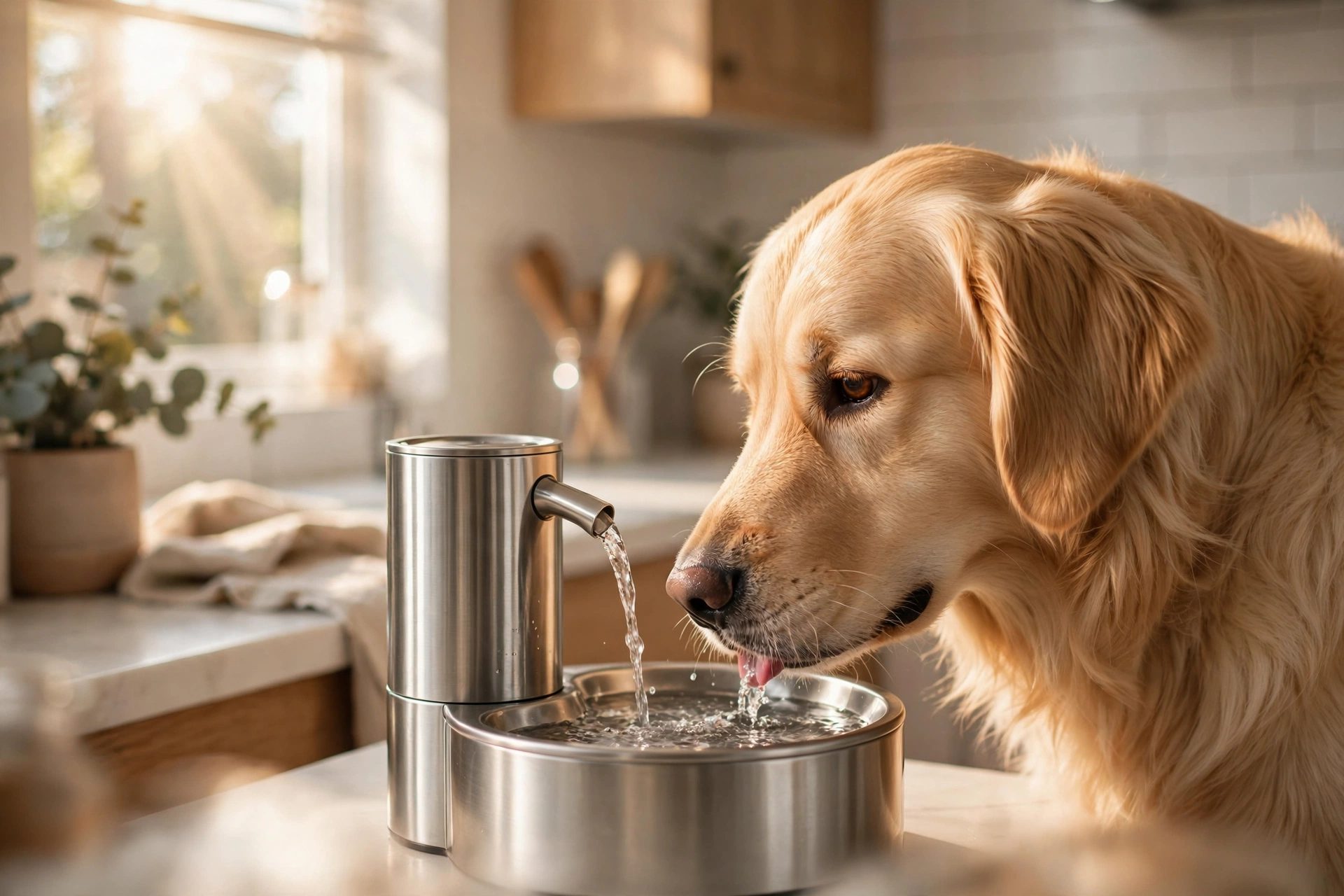
Quick verdict
A pet water fountain is a small, quiet upgrade that genuinely changes drinking behavior: moving, aerated water stays fresher and cooler than a still bowl, and many dogs — like cats — simply drink more from running water. That matters for dogs that don't drink enough, for multi-pet households, and in summer. The trade-off is maintenance: filters need replacing and pumps need cleaning on a schedule, or the fountain becomes dirtier than the bowl it replaced. If you'll commit to the cleaning routine, a fountain is worth it. If you won't, a big fresh bowl changed twice daily is the better honesty.
The real-life scenario
You fill the water bowl in the morning. By afternoon it's got a faint film on top, a few kibble crumbs floating in it, and the waterline has barely moved — your dog drank at breakfast and hasn't touched it since. You change it, and the dog drinks eagerly from the fresh bowl, which tells you something: it's not that the dog isn't thirsty, it's that the water was unappealing.
Dogs are drawn to fresh water the way we're drawn to a cold glass over a lukewarm one that's been sitting out. In the wild, moving water is safer water — still water is where things grow — and that instinct survives in domestic dogs. A fountain plays directly to it: the water circulates through a filter, stays oxygenated, and has the movement that signals "fresh" to the dog's brain. Owners who switch often notice the dog visiting the fountain more often and drinking more per visit, which is exactly the outcome for dogs prone to urinary issues or constipation, where vets routinely recommend increasing water intake.
How it works
A pet water fountain is a small recirculating system. A low-voltage pump lifts water from the reservoir to a spout or waterfall surface, it flows down into the drinking basin, and the cycle repeats. Along the way, the water passes through filtration — typically a carbon filter that reduces odors and improves taste, and often a foam pre-filter that catches hair and debris before they reach the pump.
The filtration is doing real work. Carbon filters adsorb the chlorine taste and the stale notes that build up in standing water, which is why dogs often prefer fountain water to bowl water that's technically the same age. The circulation also inhibits the biofilm — that slippery coating — from forming as fast, because biofilm establishes more readily in stagnant water.
But here's the honest mechanics note: a fountain doesn't eliminate cleaning, it changes the schedule. The pump chamber, the spout, and the basin all accumulate mineral scale and slime, and a filter past its replacement date stops filtering. Based on published specifications, most manufacturers recommend filter changes every two to four weeks and a full disassembly clean on a similar cadence. Skip it, and you have an expensive machine circulating dirty water — worse than a simple bowl.
What to look for before you buy
Capacity versus your household. A fountain that needs refilling daily for a large dog defeats the low-maintenance promise. Check the reservoir volume against realistic daily intake — a big dog in summer can drink a lot — and size up for multi-pet homes. Running a pump dry shortens its life fast.
Material: stainless steel wins for most. Plastic fountains are cheaper but develop micro-scratches that harbor biofilm and can cause chin acne in sensitive dogs — the same tradeoffs covered in our bowl materials comparison. Stainless steel resists biofilm, goes in the dishwasher, and lasts. Ceramic is the other good option, with similar hygiene advantages and a heavier, tip-resistant base.
Pump noise. Fountains run continuously, and the good ones are near-silent. Cheap pumps hum, rattle, or whine — and a fountain in the kitchen that you can hear from the couch will get unplugged within a week. Look for explicit quiet-pump design in the published specifications, and note that low water levels make any pump louder, so capacity and noise are linked.
Filter availability and cost. The fountain is the cheap part; filters are the subscription. Before buying, check that replacement filters are widely available and note their cost and replacement interval. A fountain whose proprietary filters are hard to find becomes a paperweight.
Cleaning design. You'll disassemble this regularly, so it should come apart without tools and have no fiddly crevices you can't reach with a brush. Dishwasher-safe components are a real quality-of-life feature. The Veken Pet Fountain, for example, is designed with a wide basin and a simple pump housing specifically to make the regular clean quick.
Power and placement. Fountains need an outlet nearby, and the cord should route neatly — ideally with a cord cover if you have a chewer. Consider where the fountain will live: hard floors handle the inevitable splashes better than carpet.
Veken Pet Fountain by Veken
Best for: Multi-pet households, Owners who want easy cleaning
- Stainless steel basin that resists biofilm, per manufacturer specs
- Recirculating pump with multi-stage filtration, per manufacturer specs
- Large-capacity reservoir for multi-pet use, per manufacturer specs
- Quiet pump design, per manufacturer specs
What we like
- Stainless steel is more hygienic than plastic
- Wide basin is simple to wipe down
- Good capacity for dogs plus other pets
Tradeoffs
- Filters are an ongoing cost
- Needs regular disassembly cleaning like all fountains
Based on published specifications · Last checked 2026-10-08
PetSafe Drinkwell Platinum Pet Fountain by PetSafe
Best for: Large dogs with high water intake, Households wanting a long-running fountain line
- High-capacity reservoir, per manufacturer specs
- Replaceable carbon filter for taste and odor, per manufacturer specs
- Free-falling water stream to encourage drinking, per manufacturer specs
- Dishwasher-safe components (excluding pump), per manufacturer specs
What we like
- Long-established design with widely available filters
- Large reservoir suits big drinkers
- Falling stream appeals to running-water preferrers
Tradeoffs
- Replacement filters add up over time
- Pump chamber needs scheduled descaling in hard-water areas
Based on published specifications · Last checked 2026-10-08
FAQ
Will a fountain actually make my dog drink more?
For many dogs, yes — the fresh taste and movement consistently attract more visits than a stale bowl, and this is one of the most commonly reported owner observations. It's not guaranteed for every dog; some are perfectly happy with a bowl. But for dogs that under-drink, it's the easiest intervention to try.
How often do I need to clean it?
Plan on a full disassembly and scrub every one to two weeks, plus filter changes per the manufacturer's schedule — usually every two to four weeks. In hard-water areas, mineral scale builds faster and you'll clean more often. If that sounds like too much, be honest with yourself and stick with bowls.
Are fountains safe for puppies?
Yes, with supervision — the main risks are chewing the cord and the small parts of the pump assembly. Keep the cord routed out of reach, and make sure a small puppy can't knock the unit over or get stuck investigating it. Most fountains are low-voltage, which limits the electrical risk.
My dog is scared of the running water. What now?
Start with the fountain unplugged so it's just a bowl, let the dog drink from it for a few days, then run it on the lowest setting while the dog is nearby but not forced to approach. Most dogs come around within a week. If the dog remains genuinely frightened, don't force it — a stressed dog drinks less, which is the opposite of the goal.
Can one fountain serve a dog and a cat?
Usually yes, and multi-pet households are one of the best use cases — just size the capacity for the combined drinking. The one caveat: some dogs drink so enthusiastically they splash or drain a cat-sized fountain, so if the size gap is large, get the bigger unit.
The bottom line
A pet water fountain is one of those products where the mechanism is sound — fresher, moving, filtered water genuinely appeals to dogs — and the only real question is whether you'll maintain it. Choose stainless steel, size the reservoir honestly, confirm filter availability before you buy, and commit to the cleaning schedule. Do that, and you'll have a dog that drinks more water from a cleaner source. Skip the maintenance, and you've bought an expensive dirty bowl.
More in Feeding & Treats
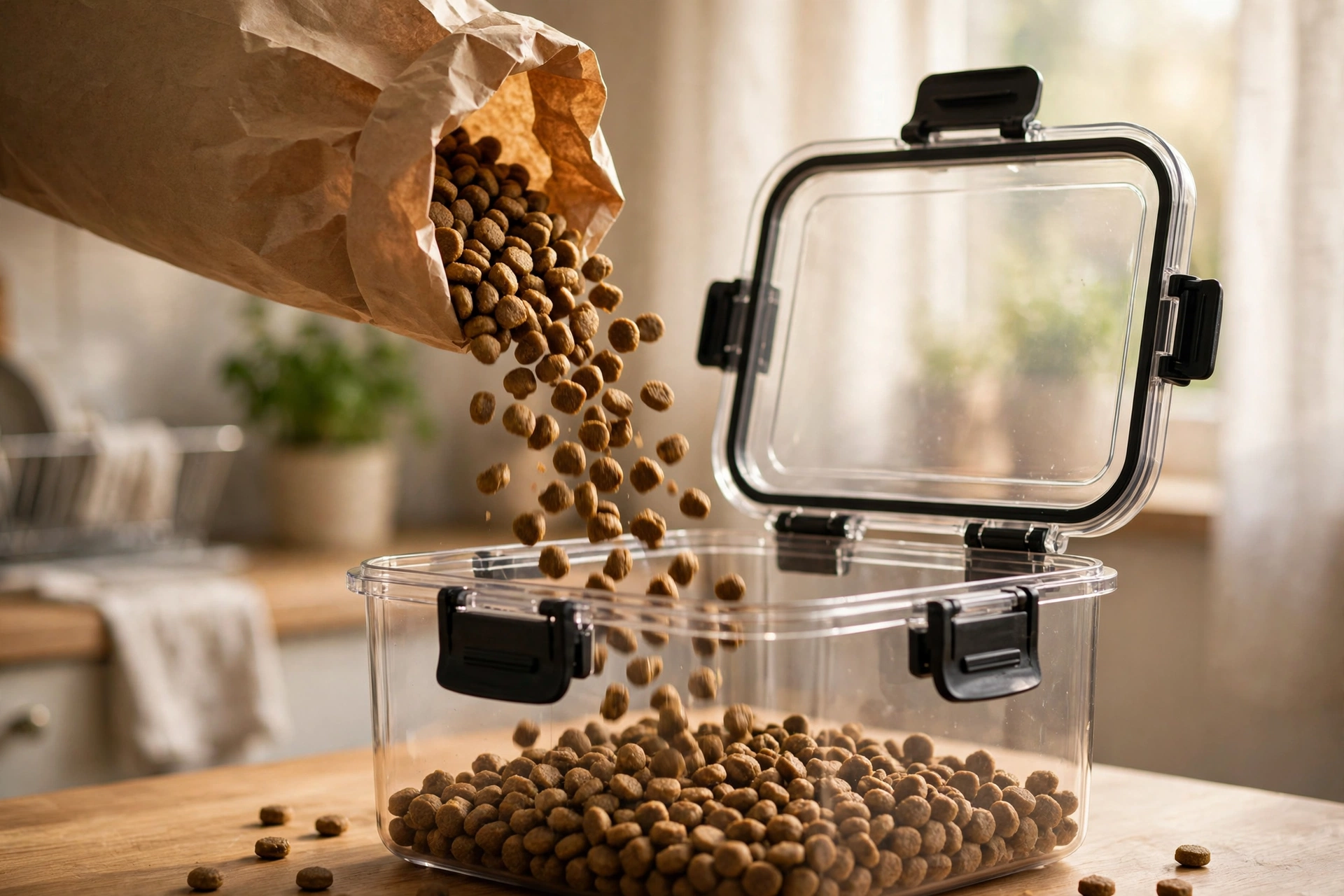
Dog Food Storage Containers: Keeping Kibble Fresh for Weeks
Kibble starts going stale the moment the bag opens. Here's how airtight containers work, what makes a seal actually airtight, and how to size one to the bag you buy.
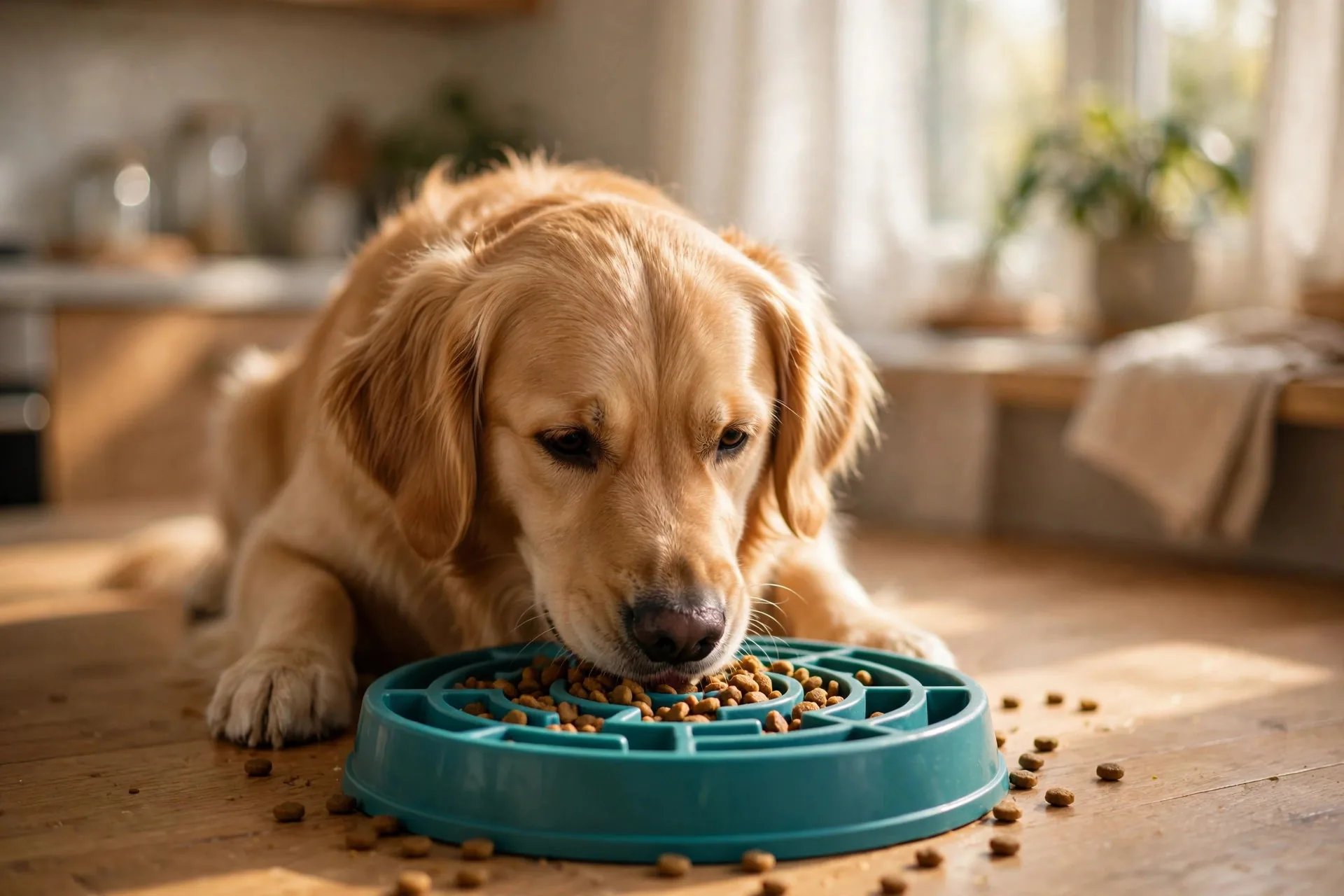
Slow Feeder Bowls for Dogs Who Inhale Dinner: Do They Actually Work?
Does a maze bowl actually slow down a dog that inhales dinner? We break down how slow feeders work, when they help, and which designs suit which dogs.

Dog Travel Water Bottles: What Actually Works on Hikes and Road Trips
Leak-proof, one-hand operation, enough capacity for the trail — here's what separates a good dog travel bottle from a soggy backpack.