Quick verdict
A treat-tossing pet camera is a great "check-in" tool and a mediocre enrichment device. If your goal is watching your dog while you're at work, getting barking alerts, and occasionally tossing a treat at lunch — it delivers that, provided your Wi-Fi is solid. But don't buy it expecting to fix separation anxiety: for some dogs, hearing your voice from a speaker while you're nowhere to be found makes the anxiety worse. The camera is the useful part. The treat tosser is a fun bonus, not a behavior solution.
The real-life scenario
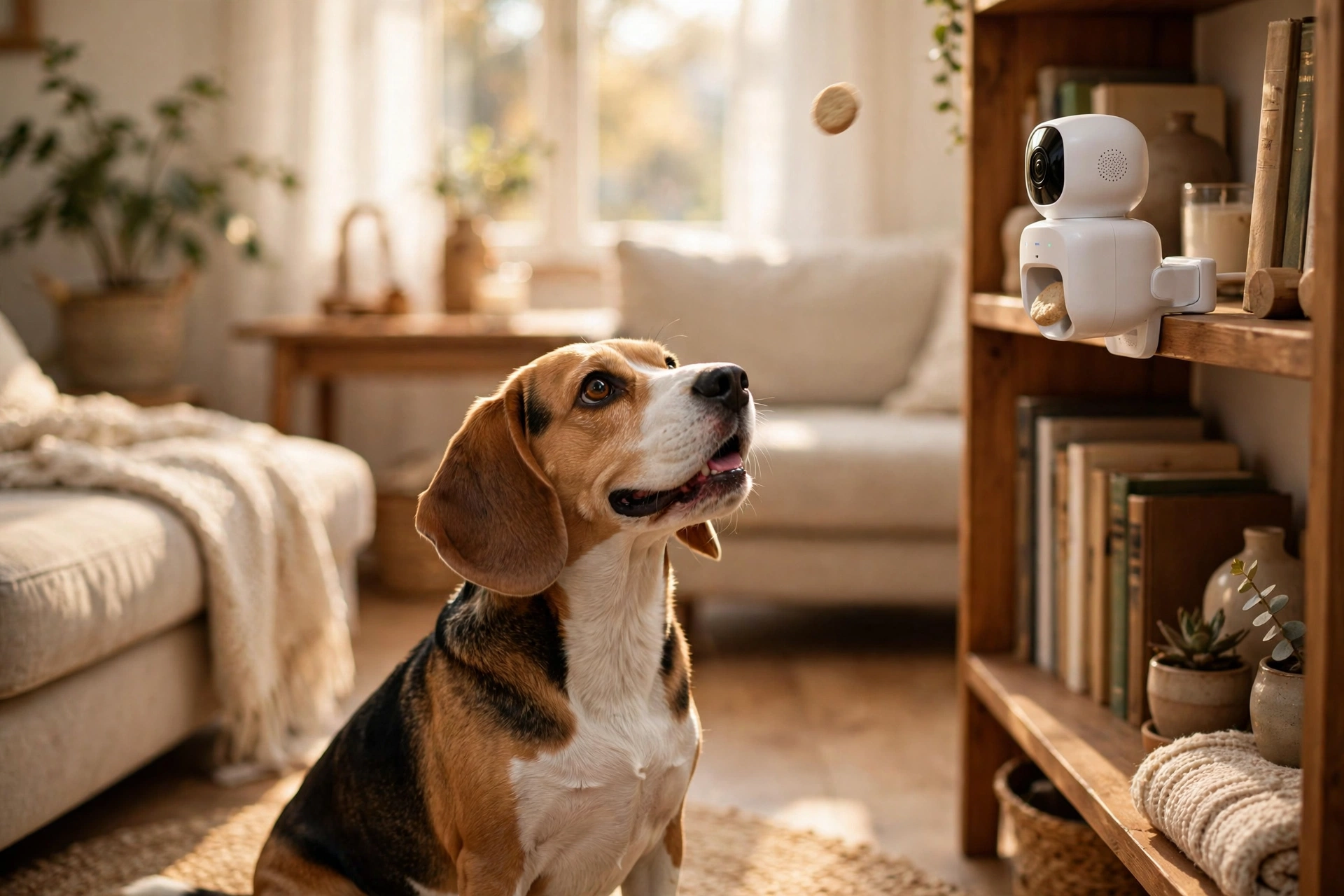
It's 1 p.m. on a Tuesday. You open the app: your beagle is asleep on the couch. You tap the treat button — the camera clicks, a treat arcs through the air, and he wakes up, looks confused, eats it, lies back down. Three minutes of joy, and honestly that little ritual is why most people buy these.
The reality check comes at month two. You use the treat toss constantly in week one, occasionally in week three, and by month two you're mostly just checking the camera while the tosser collects dust. Ask before you buy whether the camera features alone justify the price — because that's how most owners end up using it.
What treat-tossing cameras actually do well
The feature set is consistent across models: a wide-angle camera with night vision, a microphone and two-way speaker, motion and barking alerts, and a treat hopper that launches small treats when you tap a button in the app.
A camera tells you whether the barking is boredom, a delivery truck, or panic — three different problems needing three different responses. For puppies in crate training, a quick visual check beats worrying all afternoon.
The treat toss earns its keep in one scenario: rewarding calm. See your dog settling on their bed mid-morning? Toss a treat — a remote reward no timed feeder can deliver.
Latency: the make-or-break detail
Everything hinges on one thing: the delay between what the dog does and what you see — and between your tap and the treat launching. Product pages show seamless interaction. Real homes have routers behind TVs, concrete walls, and dogs that move on after two seconds.
Total latency has three parts: the camera-to-app delay (a few seconds on decent Wi-Fi), your reaction time, and the treat-launch delay. By the time you see something cute and tap, the moment has passed — you're rewarding whatever the dog is doing now.
Wi-Fi placement matters more than camera specs. The camera needs strong signal — same room as the router or a mesh node nearby. Many tossing cameras only support 2.4GHz, which penetrates walls well but congests fast in apartments. Test while you're home: watch the app feed and clap, and count the seconds until the sound reaches your phone. That number is your honest latency.
Treat size and what actually fits
The number-one complaint in owner reviews isn't the camera — it's the hopper jamming. The mechanism has to grab exactly one treat and launch it; anything sticky, crumbly, or oddly shaped defeats it.
What works: small, hard, round treats roughly pea-sized up to about 2 cm — the kind sold as training treats. What doesn't: soft or semi-moist treats (they gum up the paddle), long sticks, flaky coatings, and oversized biscuits. Mixing sizes in one fill causes jams too — stick to one treat type at a time.
Cleaning is part of the routine: wipe the hopper and launching tube weekly, since treat dust causes most under-tossing and double-firing — and the fix is a five-minute clean, not a warranty claim. Mount the camera out of chew range, too: some curious dogs will treat it as the ultimate puzzle toy.
Anxious dogs: the honest part
The marketing shows a worried dog hearing their owner's voice and calming down. Sometimes that happens. Often the opposite does: an anxious dog hears your voice, can't find you, and the searching gets more frantic — pacing and whining, now aimed at the camera instead of the door.
Test it while you're home first. Sit in another room, talk through the speaker, toss a treat — and watch your dog's body language honestly. Calm curiosity is a green light. Pacing, panting, or fixating on the speaker is your answer: for this dog, the camera is surveillance only — no voice, no treats while you're gone.
If your dog responds well, reward settling, not excitement: a treat launched while your dog lies calmly on their calming bed strengthens the settle. And no camera replaces the fundamentals for real separation anxiety — gradual departures, desensitization, and in serious cases a vet or behaviorist.
What to look for before you buy
Decide whether the camera alone is worth it. Would you still pay for the video quality, alerts, and night vision without the tosser? If the toss is the only reason you're buying, keep your money — the novelty wears off.
Check the stated treat-size range first. Buy one small bag of compliant treats and test before buying in bulk — a cupboard of unlaunchable treats is an expensive mistake.
Count the ongoing costs. Some cameras gate video history or smart alerts behind a subscription. A "cheap" camera with a mandatory monthly plan costs more by year two than the pricier model with local storage.
Think about placement. High enough that your dog can't reach it, angled at the spots your dog actually uses (the couch, the crate area, the door), and within solid Wi-Fi range. "I'll figure it out later" is how cameras end up filming an empty hallway.
Multiple dogs? Expect unequal treats. Barking alerts can't tell your dogs apart, and one dog will hoover every treat while the shy one watches. In multi-dog homes, the camera's real value is observation.
FAQ
Will a treat-tossing camera fix my dog's separation anxiety?
No — and for some dogs it can make it worse. Hearing your voice without your presence can increase searching and frustration. The camera is excellent for monitoring whether training is working, but the training itself is what changes the behavior.
What treats work in a tossing camera?
Small, hard, round treats — pea-sized up to about 2 cm, like standard training treats. Avoid soft or semi-moist treats (they gum up the paddle), flaky coatings, and anything oversized. Stick to one treat type per fill.
Why does my camera lag?
Latency usually comes from your Wi-Fi, not the camera. Concrete walls, distance from the router, and congested 2.4GHz networks all add delay. Move the camera closer to the router: a few seconds of lag is normal; ten-plus means a network problem.
Can I use the treat tosser for training while I'm away?
Only loosely. Latency means the dog has usually moved on by the time your tap becomes a treat. What does work: rewarding calm states. See your dog settling on their bed? Toss a treat — that reinforcement doesn't need perfect timing.
Is it safe to leave the camera on all day?
Yes, with two conditions: it's mounted out of your dog's reach, and you've considered privacy — check the manufacturer's data policy, and tell anyone else in the household it's there.
How often should I clean the treat hopper?
Weekly. Treat dust and crumbs accumulate fast, and most "my camera stopped tossing properly" complaints are really "my camera hasn't been cleaned in a month."
The bottom line
A treat-tossing pet camera is worth buying for what the camera does: watching, alerting, and reassuring you that the dog is fine. The treat tosser is a genuinely fun bonus and a decent remote reward for calm behavior — as long as your Wi-Fi keeps latency honest and your treats are the right size. For anxious dogs, test it while you're home first: the voice that comforts one dog can unsettle another. Buy the camera for the camera; enjoy the treats.
More in Home & Sleep
Ramps vs Pet Stairs for Senior Dogs: Which One Actually Protects Their Joints?
For most senior dogs, a ramp beats stairs — and the worse the joints, the clearer the answer. Slope, surface and sizing compared, plus how to train a hesitant senior to actually use the aid.
Enzymatic Cleaners for Pet Stains and Odors
Urine odor that keeps coming back isn't a cleaning failure — it's chemistry. How enzymatic cleaners digest the residue regular cleaners leave behind, and how to apply them so they finish the job.
Dog Gates and Playpens: Creating Safe Home Zones
Pressure-mounted or hardware-mounted? Gate or playpen? How to divide your home into safe zones for a puppy — matching the barrier to the location, the athlete, and your daily routine.