Quick verdict
For urine, vomit, and other organic pet messes, enzymatic cleaners are the category that actually solves the problem rather than covering it up. The enzymes break down the proteins and uric acid crystals that cause lingering odor — the stuff regular soap and scented sprays leave behind. They're not instant magic: they need dwell time, the right application, and sometimes a second round. But if you've ever cleaned a spot, watched it look fine, and then smelled it again on a humid day, an enzymatic cleaner is what was missing.
The real-life scenario
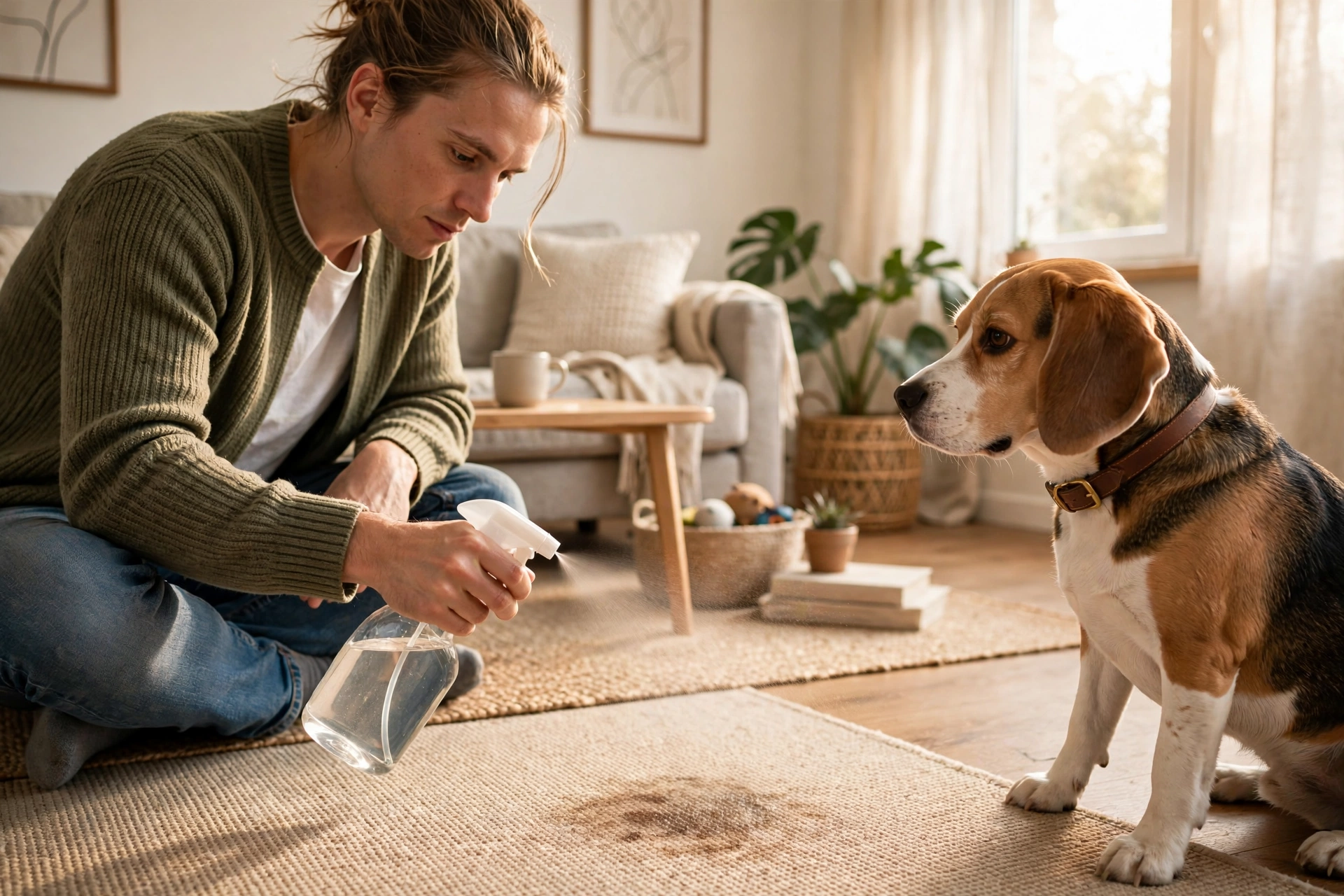
Tuesday night, 11 p.m. The puppy had an accident on the living room rug three days ago. You cleaned it immediately — paper towels, carpet foam, the whole routine. It looked clean. But tonight, with the heating on and the air warm, the corner of the room smells faintly, unmistakably of urine. You scrub it again. It fades. It comes back. The stain isn't the problem anymore; what's left is invisible, and it's winning.
Here's what's happening: urine contains uric acid, which forms crystals that bind to carpet fibers and padding. Regular cleaners wash away the visible part and perfume over the rest, but the crystals stay put — and every time humidity rises, they release odor again. Your dog can smell it even when you can't, which is why she keeps returning to the same spot. Enzymatic cleaners attack exactly this residue: biological catalysts that digest the proteins and uric acid until there's nothing left to smell.
How it works
An enzymatic cleaner contains live enzyme-producing bacteria or stabilized enzymes in solution. When you saturate the soiled area, the enzymes go to work digesting organic matter — proteins, starches, uric acid — breaking them into smaller molecules that bacteria then consume, eventually leaving water and carbon dioxide. Per the manufacturer, Rocco & Roxie's Stain & Odor Eliminator uses enzymatic action to eliminate stains and odors at the source rather than masking them. Nature's Miracle, per the manufacturer, uses a bio-enzymatic formula designed to break down the proteins in pet messes. Simple Solution's Extreme formula, per the manufacturer, combines enzymatic action with odor neutralizers for a two-stage approach.
Based on published specifications, the key variable is contact time: enzymes need to stay wet on the stain for minutes to hours to finish the job. That's why the instructions on every serious enzymatic cleaner say the same things — saturate the area, cover it, let it work, don't scrub it dry after thirty seconds.
Honest mechanics notes:
- Enzymes and heat don't mix. Hot water can denature the enzymes before they work. Clean up the bulk of the mess with cool or lukewarm water first, then apply the enzymatic cleaner.
- Old set-in stains are harder. Enzymes work best on fresh messes. A stain that's been there for months may improve but not vanish — the residue has bonded deeper into the pad. Manage expectations accordingly.
- Don't mix with other cleaners first. Bleach, vinegar, and many disinfectants kill or inhibit the enzymes. If you've already treated a spot with something else, rinse it thoroughly and let it dry before applying the enzymatic cleaner.
What to look for before you buy
True enzymatic formula. The label should say enzymatic or bio-enzymatic — that's the mechanism that digests odor sources. Scented carpet foams and "odor eliminator" sprays without enzymes are masking products; they smell nice for a day and the problem returns. Read the label, not the front-of-bottle marketing.
Application format. Trigger sprays suit spot treatment on carpet and upholstery. Pour-cap or gallon jugs are for saturating large areas or treating carpet padding — serious urine soaks go deep, and a spritz on the surface won't reach the pad. Buy the format that matches your actual problem; a gallon jug is the economical choice for a new puppy.
Surface safety. Most enzymatic cleaners are safe for carpet, upholstery, and hard floors per the manufacturer, but always spot-test in an inconspicuous area first, especially on natural fibers, leather, and unfinished wood. Enzyme solutions need to stay damp to work, and prolonged dampness is exactly what some materials don't like.
Scent level. Enzymatic cleaners typically have a mild scent that fades as the product dries. If anyone in the house is fragrance-sensitive, look for unscented or lightly scented options — and remember the goal is no smell at all, including no cleaner smell, once it's done working.
Patience built into the routine. The best cleaner fails if you wipe it up after two minutes. Look for clear dwell-time instructions on the label, and plan the application around them — evening application with overnight dwell time is the classic approach for a reason.
For rugs specifically, an enzymatic cleaner pairs well with a rug you can actually wash. Our guide to washable rugs for muddy paws covers options that survive both the mess and the machine.
Rocco & Roxie Stain & Odor Eliminator by Rocco & Roxie
Best for: Old or recurring urine spots, Carpet and upholstery, Multi-pet households
- Enzymatic formula targets stains and odors at the source, per manufacturer specs
- Safe for carpets, upholstery, and most hard floors when used as directed, per manufacturer specs
- Certified safe for use around pets and children when used as directed, per manufacturer specs
What we like
- Enzymes digest odor-causing residue rather than masking it
- Works on old stains with proper dwell time
- Mild scent that fades as it dries
Tradeoffs
- Needs generous saturation and dwell time to work
- Gallon size is the economical buy for big jobs
Based on published specifications · Last checked 2026-10-08
Nature's Miracle Advanced Pet Stain & Odor Eliminator by Nature's Miracle
Best for: Fresh puppy accidents, Vomit and drool stains, Quick spot treatment
- Bio-enzymatic formula breaks down proteins in pet messes, per manufacturer specs
- Suitable for carpets, hard floors, and fabrics, per manufacturer specs
- Light fresh scent, per manufacturer specs
What we like
- Widely available and easy to find
- Effective on fresh messes with short dwell time
- Versatile across surfaces
Tradeoffs
- Deep, old urine may need a second application
- Scent may be noticeable to fragrance-sensitive users
Based on published specifications · Last checked 2026-10-08
Simple Solution Extreme Pet Stain and Odor Remover by Simple Solution
Best for: Strong lingering odors, Cat and dog urine alike, Budget-conscious buyers
- Enzymatic action plus odor neutralizers for a two-stage approach, per manufacturer specs
- Designed for carpets, upholstery, and bedding, per manufacturer specs
- Pro-bacteria formula continues working after application, per manufacturer specs
What we like
- Two-stage formula tackles stain and odor together
- Good value in larger sizes
- Continues working while damp
Tradeoffs
- Must stay wet on the stain — cover to slow evaporation
- Not a substitute for extracting deep pad saturation on old stains
Based on published specifications · Last checked 2026-10-08
FAQ
How long does an enzymatic cleaner take to work?
Plan on at least 10–15 minutes of wet contact for fresh spots, and several hours or overnight for deep or old urine, per manufacturer guidance. The enzymes work while the area stays damp — cover the treated spot with a damp towel or plastic to slow evaporation on big jobs.
Why does the urine smell keep coming back after cleaning?
Uric acid crystals bind to fibers and survive ordinary cleaning; humidity reactivates them, releasing odor. It's also why your dog returns to the same spot — she smells what you can't. An enzymatic cleaner digests the crystals instead of covering them, which breaks the cycle.
Are enzymatic cleaners safe around pets and kids?
Most are designed for homes with pets and are non-toxic when used as directed per the manufacturer — but "used as directed" means keeping pets off the wet treated area until it's dry, and storing the bottle out of reach. Check the label for your specific product rather than assuming.
Can I use an enzymatic cleaner on hardwood floors?
Yes, with caution: saturate the stain, not the floor. Enzyme solutions need dwell time, and standing liquid is the enemy of wood finishes. Wipe up excess, keep the application targeted, and don't let pools sit on the boards. For sealed floors it's generally fine per manufacturer guidance; for unfinished or waxed wood, spot-test first.
Do I still need to clean the stain first?
Yes — remove as much of the mess as possible with paper towels or a wet vac before applying the cleaner. Enzymes work on residue, not on volume; giving them a head start by removing the bulk means a faster, more complete result.
The bottom line
If pet odors keep resurrecting themselves, the problem isn't your cleaning effort — it's the chemistry. An enzymatic cleaner is the one product category built to digest what causes the smell, and used with proper dwell time it ends the cycle of clean-it, smell-it, clean-it-again. Buy the size that matches your mess, saturate generously, and give it the hours it needs to finish the job.
More in Home & Sleep
Dog Gates and Playpens: Creating Safe Home Zones
Pressure-mounted or hardware-mounted? Gate or playpen? How to divide your home into safe zones for a puppy — matching the barrier to the location, the athlete, and your daily routine.
Puppy Starter Kit: The Realistic Essentials Checklist
Less than the pet store suggests, more than 'just bring a collar.' The dozen items that actually matter in month one, and what to deliberately buy later.
Dog Car Seat Covers and Hammocks: Protecting Your Car
Hammock covers protect the seat, the seatbacks, and the footwell gap in one anchored panel. What separates a real waterproof cover from a decorative one.