Quick verdict
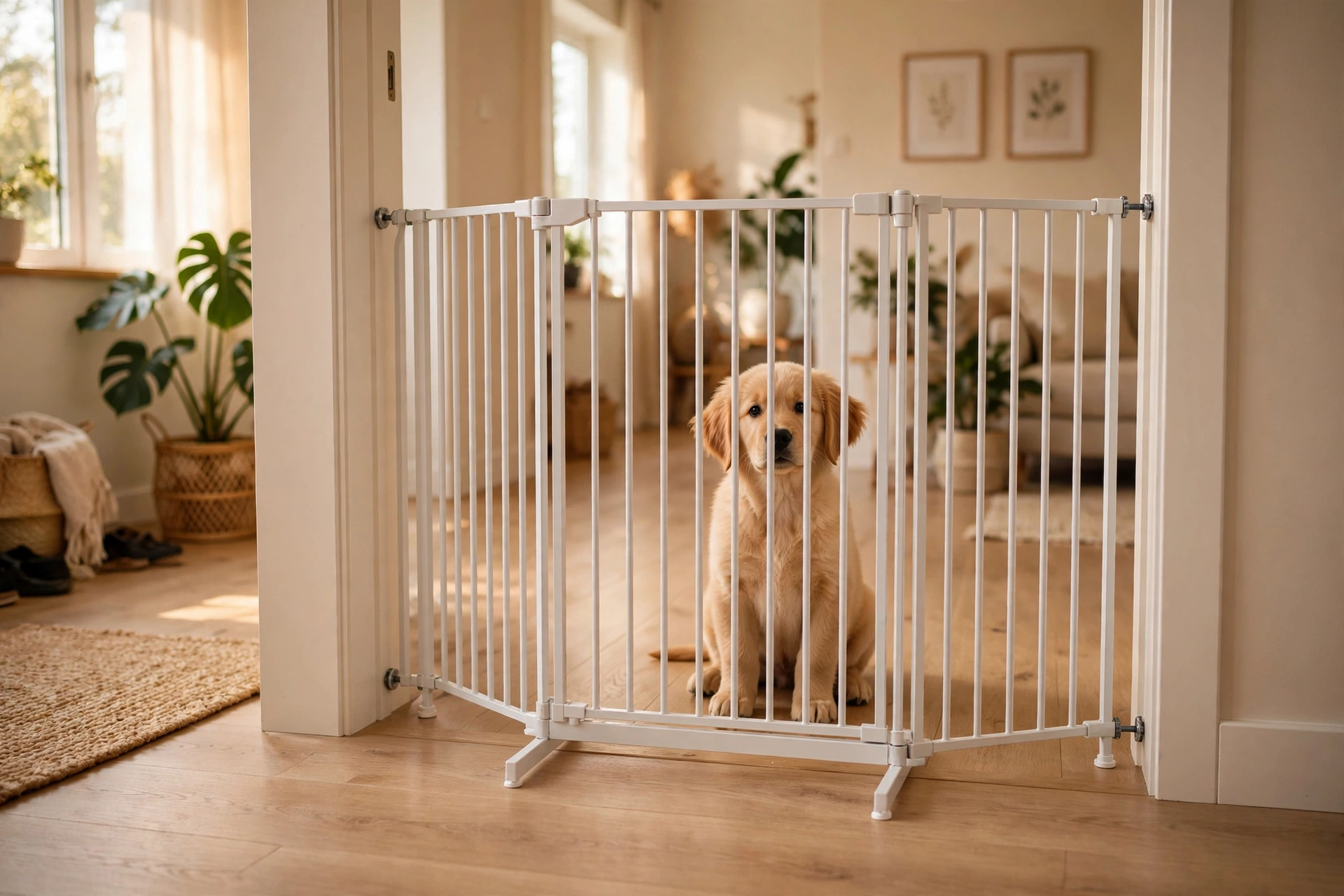
Gates and playpens are how you give a dog freedom within boundaries — the kitchen is fine, the staircase isn't; the living room yes, the nursery no. Pressure-mounted gates suit doorways and rentals, hardware-mounted gates suit staircases and determined dogs, and playpens create a room-within-a-room for puppies. The right choice depends on your dog's size, athleticism, and the stakes of the boundary. Buy for the dog you have, not the dog you hope to have: a determined chewer or a fence-jumper will defeat a flimsy gate in an afternoon.
The real-life scenario
You bring home an eight-week-old puppy on Saturday. By Sunday, she has discovered the stairs, the cat's litter box, the laundry room with its open detergent shelf, and the exact spot behind the sofa where the cables live. You spend the day shadowing her like a Secret Service detail, and by evening you understand: you cannot watch her every second, and she cannot be trusted for any second. What you need isn't more vigilance — it's architecture.
That's the job of gates and playpens. A gate across the hallway turns the puppy-proofed kitchen into a safe zone where she can play, nap, and be a puppy without a chaperone. A playpen in the living room gives her a den that travels with family life instead of isolating her in a back room. The house stays sane, the puppy stays safe, and nobody has to choose between the dog and the drywall.
How it works
Pet gates divide space with a barrier the dog can't pass but people can — usually via a walk-through door with a latch. Pressure-mounted gates wedge between two walls or a doorframe using tension bolts; they install in minutes and leave no marks, which makes them the default for renters and standard doorways. Hardware-mounted gates screw into the wall or banister; they're the sturdier option and the only type most safety guidance recommends for the top of stairs, where a gate failure could mean a fall.
Playpens work differently: instead of blocking a passage, they enclose an area. Panel-style playpens (like the IRIS USA 4-panel pen) form a freestanding octagon or square that you can shape to the room and fold flat when not needed. Per the manufacturer, the IRIS pen uses durable molded plastic panels that connect without tools. Wire exercise pens do the same job in metal — heavier, but more resistant to chewing.
Walk-through gates from brands like Regalo and Carlson Pet Products are the workhorses of this category. Per the manufacturer, Regalo's Easy Step Walk Thru gate uses a lever handle designed for one-hand operation — you can carry a laundry basket through it — and expands to fit a range of doorway widths. Carlson's Extra Wide Walk-Through gate, per the manufacturer, includes a small pet door so a cat can pass while the dog stays put, a detail cat-and-dog households appreciate immediately.
What to look for before you buy
Mounting type versus location. This is the safety-critical decision. Top of stairs: hardware-mounted, always — a pressure gate can be dislodged by a dog throwing its weight against it, and the consequence is a fall. Doorways and hallways on level ground: pressure-mounted is fine and far easier to install and move.
Height and your dog's athleticism. Measure honestly. A gate that reaches your knee contains a basset; it will not contain a young border collie with opinions about verticality. For jumpers and climbers, taller gates with vertical bars (no horizontal footholds) are the answer — and accept that no freestanding barrier stops a truly determined athlete.
Walk-through convenience. You'll open this gate dozens of times a day. A walk-through door with a latch you can operate one-handed is worth real money; a gate you have to step over becomes a tripping hazard you'll eventually remove in frustration. Check the latch mechanism — can you work it with a full laundry basket in your arms?
Bar spacing. Narrow enough that your dog can't squeeze through or get a head stuck. This matters most for puppies and small breeds: check the manufacturer's bar-spacing specification against your dog's size, and remember puppies grow into gaps you thought were fine.
Playpen size and stability. A playpen should be large enough for a bed, water, and some play space — cramped pens get ignored or escaped. On slick floors, look for non-skid feet or rubber caps; a pen that slides when the puppy launches off the walls isn't containing anything.
Chew resistance. Determined chewers will test every bar and joint. Metal gates outlast plastic for heavy chewers, and powder-coated steel resists both teeth and rust. If your dog chews barriers, budget for metal.
Gates handle boundaries, but many puppies also need a true den for naps and enforced rest — that's where a crate earns its place. Our guide to dog crates for training and travel covers sizing and crate training done right.
Regalo Easy Step Walk Thru Gate by Regalo
Best for: Hallways and doorways, Renters (pressure-mounted, no screws), Owners carrying laundry, kids, or groceries through daily
- Lever-style handle designed for one-hand operation, per manufacturer specs
- Pressure-mounted installation — no tools or wall damage, per manufacturer specs
- Expands to fit a range of doorway widths, per manufacturer specs
What we like
- Walk-through door saves endless stepping-over
- Installs in minutes with no tools
- Sturdy all-steel construction
Tradeoffs
- Pressure-mount not recommended for top of stairs
- Lever latch may be learnable by very clever dogs
Based on published specifications · Last checked 2026-10-08
Carlson Extra Wide Walk-Through Pet Gate with Small Pet Door by Carlson Pet Products
Best for: Wide openings, Homes with both cats and dogs, Doorways needing a walk-through door
- Built-in small pet door lets cats pass while dogs stay put, per manufacturer specs
- Pressure-mounted with walk-through door, per manufacturer specs
- Expandable width fits wider openings, per manufacturer specs
What we like
- Cat door solves the classic multi-pet problem
- Fits openings too wide for standard gates
- Solid steel frame
Tradeoffs
- Small pet door won't suit larger cats
- Pressure-mount only — not for stair tops
Based on published specifications · Last checked 2026-10-08
IRIS USA 24" Exercise 4-Panel Pet Playpen by IRIS USA
Best for: Puppies and small dogs, Creating a play zone in the living room, Travel and temporary setups
- Durable molded plastic panels connect without tools, per manufacturer specs
- Configurable shape adapts to the room, per manufacturer specs
- Folds flat for storage, per manufacturer specs
What we like
- Tool-free setup and easy reconfiguration
- Lightweight and portable
- Smooth plastic is easy to wipe clean
Tradeoffs
- Not chew-proof for determined chewers
- Light enough that large dogs can push it
Based on published specifications · Last checked 2026-10-08
FAQ
Pressure-mounted or hardware-mounted — which do I need?
For doorways and hallways on flat ground, pressure-mounted gates are convenient, renter-friendly, and strong enough for most dogs. For the top of stairs, choose hardware-mounted — it's screwed into the wall and can't be knocked loose by a dog leaning or jumping on it. The location decides; don't economize at the stairs.
Will a gate work for a dog that jumps?
Up to a point. Extra-tall gates (36 inches and up) with vertical bars stop most casual jumpers, especially when the dog learns the boundary is consistent. But a young, athletic dog that's motivated — separation anxiety, another dog on the other side — can clear surprising heights. For those cases, the gate is a management tool while you train the underlying behavior, not a permanent solution.
What's the difference between a playpen and a crate?
A crate is a den — small, enclosed, for sleeping and settling. A playpen is a yard — bigger, open-topped, for playing safely while unsupervised. Puppies generally need both: the pen for awake time in the family space, the crate for naps and nights.
Can I use a baby gate for a dog?
Sometimes — many are structurally identical to pet gates. But pet-specific gates often have features baby gates lack: smaller bar spacing for small dogs, pet doors for multi-pet homes, and taller options for jumpers. Check the specifications rather than the label; the mounting and strength math is the same.
How do I stop my dog from barking at the gate?
The gate creates frustration when the dog wants to be on the other side — barking at the barrier is normal at first. Don't make the gate the focus: reward calm behavior near it, make the gated zone genuinely pleasant (chews, bed, you nearby), and avoid using the gate only when you leave, which teaches the dog that gate equals abandonment.
The bottom line
A gate or playpen doesn't restrict your dog's life — it expands the parts of the house where she can safely live it. Match the mounting to the location, the height to the athlete, and the latch to your real daily routine. Done right, the barrier disappears into the background and what you're left with is a puppy who can be a puppy without a full-time guard.
More in Home & Sleep
Enzymatic Cleaners for Pet Stains and Odors
Urine odor that keeps coming back isn't a cleaning failure — it's chemistry. How enzymatic cleaners digest the residue regular cleaners leave behind, and how to apply them so they finish the job.

Puppy Starter Kit: The Realistic Essentials Checklist
Less than the pet store suggests, more than 'just bring a collar.' The dozen items that actually matter in month one, and what to deliberately buy later.
Dog Car Seat Covers and Hammocks: Protecting Your Car
Hammock covers protect the seat, the seatbacks, and the footwell gap in one anchored panel. What separates a real waterproof cover from a decorative one.