Quick verdict
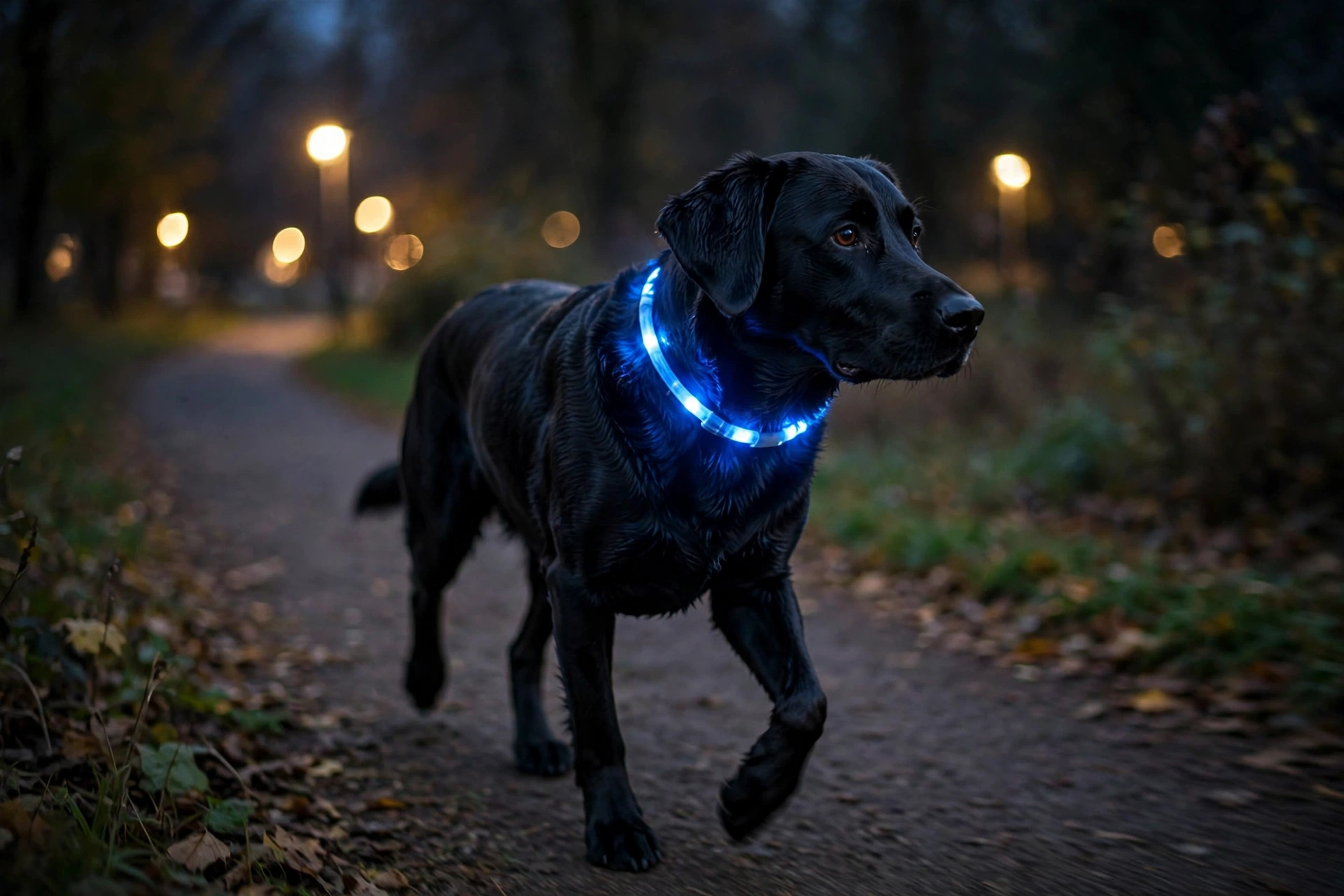
For night walks, an LED collar is the single biggest visibility upgrade you can buy — but it works best as part of a system, not as a replacement for everything else. An LED collar makes your dog visible from all directions in complete darkness, which is exactly where reflective gear fails: reflective strips only shine back when a light hits them. A light-up collar glows on its own, so a driver turning in from a side street, a cyclist on an unlit path, or another dog walker in a dark park can see your dog before any headlight reaches them. The best setup for most owners is an LED collar plus a reflective harness or leash: the LED does the work in the dark, and the reflective material takes over when headlights do hit. Pick a rechargeable collar with a bright, even glow and a steady mode — and skip dim lights with fiddly battery compartments.
The real-life scenario
It's 7 p.m. in November, properly dark, and your dog needs a walk. Under the streetlights you can see fine — but turn onto the unlit stretch of path, and your black Labrador becomes a pair of eyes and a rustle in the leaves as a jogger and a cyclist appear out of nowhere. Everyone else on the path is effectively guessing where your dog is.
The core problem isn't how well you can see your dog — it's how early other people can see them, and from which direction. That distinction is what separates LED collars from reflective gear.
Why reflective gear alone isn't enough
Reflective material is passive: it bounces light back toward the source. That works beautifully when a car's headlights are pointed at your dog, which is why reflective strips are standard on harnesses, leashes, and jackets. But reflective gear has two blind spots.
First, it needs an incoming light. On a dark trail or a side street where a driver turns in from an angle, no beam may hit the strip until the vehicle is already close — and a cyclist with a dim light, or a pedestrian with no light at all, gets almost nothing back from it.
Second, strips only face the direction of the light. A dog crossing your path at an angle may show very little reflective surface at the moment it matters. Reflective gear is excellent backup, but it can only answer a light that's already there.
What an LED collar actually does
An LED collar is active: it produces its own light, visible in every direction, whether or not anything is shining at your dog. The light usually runs the full length of the collar as a glowing tube or strip, so the dog reads as a moving ring of light rather than a single blinking dot. That shape matters — a glowing ring is instantly recognizable as a dog, while a single blinking point could be anything from a bike light to a phone screen.
Most collars offer steady glow and flashing modes. Steady is the better default: easier for others to track, less distracting for your dog, and less annoying to other path users. Flashing stands out more on busy, lit streets but can overstimulate light-sensitive dogs — if your dog paws at the collar, try steady mode first.
Brightness varies enormously, and it's what separates a good collar from a gimmick. A collar that looks bright in a dark-room product photo can be barely visible under streetlights. Look for a glow that is even along the whole length, with no dark patches at the clasp, and test it on your first walk: stand back at path distance and check you can follow your dog's movement, not just spot a glow when you look straight at them.
LED collars vs reflective gear at a glance
| LED collar | Reflective gear | |
|---|---|---|
| Works in total darkness | Yes — it makes its own light | No — needs an incoming light |
| Visible from all directions | Yes, a glowing ring | Only from the direction of the light |
| Works for people without lights | Yes — pedestrians, other dog walkers | Barely — nothing to bounce back |
| Needs power | Yes — battery or rechargeable | No |
| Fails when | Battery dies mid-walk | No light source is aimed at the dog |
| Best role | Primary night visibility | Backup that shines under headlights |
The takeaway is simple: don't choose one. An LED collar with a reflective harness or leash covers both failure modes — the dark path with no lights, and the road where headlights do the work.
Battery types: the real ownership cost
Battery design decides whether an LED collar becomes a daily habit or a drawer ornament.
Rechargeable (USB). The best option for most owners — charge it like a phone, every few days to a couple of weeks depending on walk length and mode. The catch is remembering: a dead collar on a dark night is worse than no collar, because you may assume you're visible when you're not. Plug it in after the evening walk and make it routine.
Coin-cell batteries. Common in the cheapest collars: light and slim, but they run out faster, cost money over time, and the screw-down compartments are fiddly in the cold. Worse, a chewed-open collar can expose a coin cell, which is a genuine swallowing hazard — a bad match for chewers.
Replaceable AAA or similar. Cheap to run and easy to swap, but heavier and bulkier on a small dog's neck, and the compartment is a weak point for water ingress.
Whatever type you choose, check water resistance for rainy walks and that the battery or charging port sits where your dog can't chew it.
Fit, comfort, and dogs who hate wearing things
The usual fit rules apply: two fingers between collar and neck, and the collar shouldn't rotate so the light ends up under the chin where nobody can see it. Many LED collars are a tube you cut to size — measure first and cut conservatively, since you can't add length back.
Introduce it indoors first: worn switched off for a few minutes with treats, then switched on in a familiar room, so the light isn't a surprise on top of a dark walk. If your dog already walks in a harness, you can often thread the LED collar through it as a light strip — pairing naturally with a harness that fits well.
One caution: never use the LED collar as the leash attachment unless it's built for it. Most are visibility accessories, not load-bearing collars — clip the leash to the regular collar or harness. The same logic applies to your leash choice at night: a standard leash gives more control than a retractable one when visibility is low.
A note on light-sensitive dogs
A collar light sits below and behind the dog's eyeline, so it doesn't shine into their eyes the way a headlamp would, and most dogs ignore it. If yours seems unsettled, switch from flashing to steady mode and check the fit — a collar that's too tight or rotating under the chin is more likely to be the problem than the light itself.
The bottom line
An LED collar won't make a night walk risk-free — you still need a leash, awareness, and a route you trust. But it fixes the specific problem reflective gear can't: being visible in real darkness, from every direction, to people who aren't shining a light at your dog. The case is strongest for dark-coated dogs, who vanish first in low light, and small dogs, who sit below headlight beams. Choose a rechargeable collar with an even, bright glow and a steady mode, fit it properly, keep it charged, and pair it with reflective gear for the headlight moments. For a dog you walk after dark all winter, it's one of the cheapest safety upgrades you'll ever buy.
More in Walk Gear

Dog First-Aid Kit Essentials: What to Pack for Walks and Hikes — and What to Leave Out
A palm-sized kit covers almost every walk injury: what to pack, how to treat cut paws, stings and ticks on the trail, and what to leave at home.

Dog Halloween Costumes: Cute vs Safe — What to Check Before You Buy
A costume is fine fun for fifteen supervised minutes — if it passes the safety checklist. Fit, breathing, chewable parts, stress signs, and the night's bigger hazards.
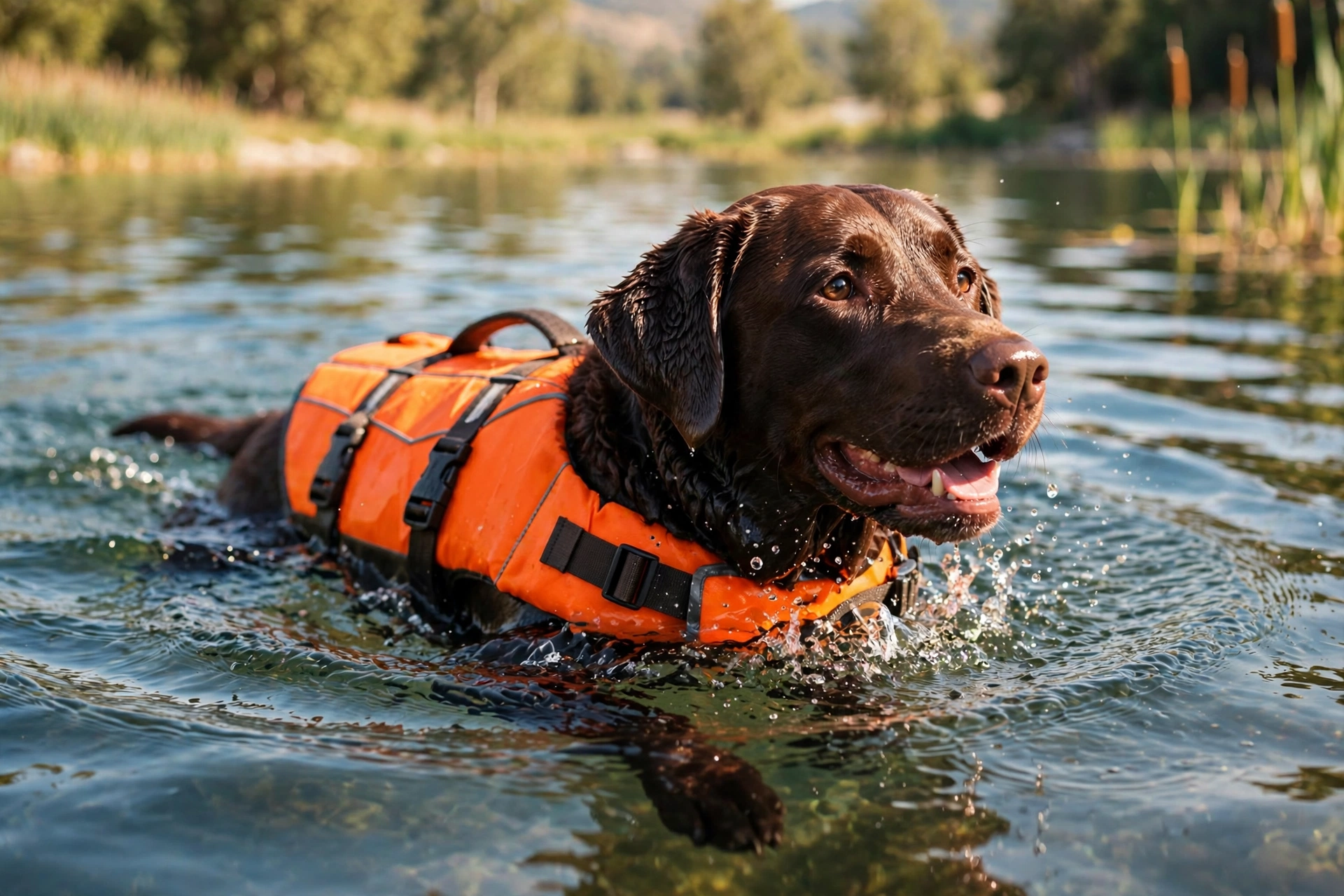
Dog Life Jackets: What Matters for Swimming Safety
Most dogs can swim, but not all swim well. Fit, buoyancy distribution, and a sturdy grab handle are what separate a real life jacket from a costume.