Quick verdict
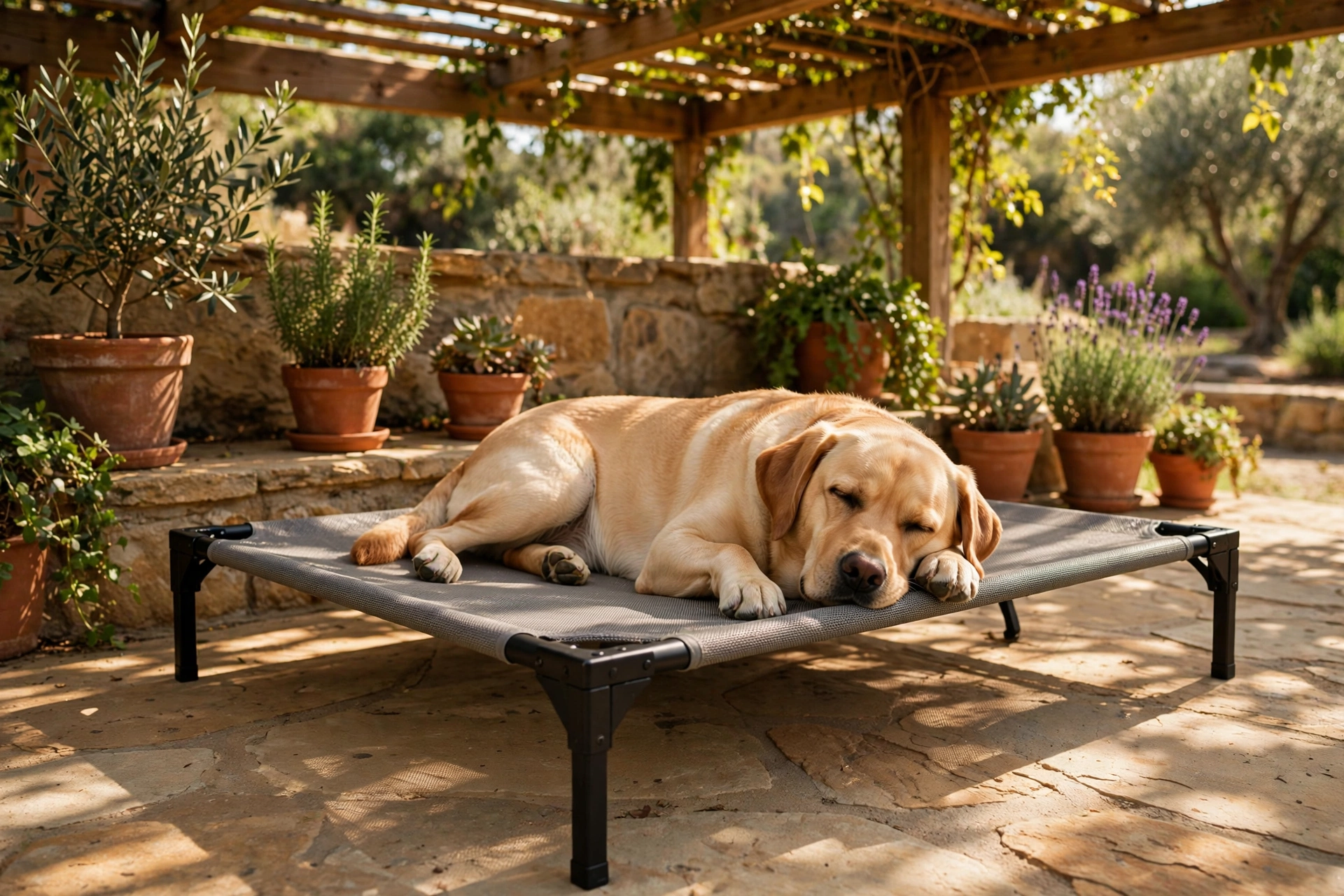
Elevated cot beds are one of the simplest ways to help your dog sleep cooler in warm weather. Raising the sleeping surface a few inches off the ground lets air circulate underneath, so the bed doesn't trap body heat the way a plush cushion does. They're sturdy, easy to hose off, and travel well. They won't air-condition your dog, and heavy dogs need a reinforced frame — but for summer napping on the patio or in a warm apartment, a cot is a genuine upgrade over a regular bed.
The real-life scenario
It's the first real heatwave of July. By noon, the patio stones are warm enough that your dog won't lie on them, so she relocates to the living room rug — and starts panting. You drag out her usual stuffed bed, and she lies next to it instead of on it. The plush donut that was perfect in February has become a heat trap in July, and your dog knows it before you do.
Dogs cool themselves almost entirely by panting and through the thin skin on their paws and belly, so the surface they rest on matters enormously in summer. A stuffed bed holds warmth against the body; a cot lets air move underneath it, wicking heat away with every breath of breeze. If your dog has been abandoning her bed for the tile floor, she's not being fussy — she's self-regulating, and a cooling cot meets her halfway.
How it works
A cot bed is a rectangular frame — usually powder-coated steel or aluminum — stretched with a breathable mesh fabric (most commonly a woven HDPE or Textilene-style fabric). The dog lies on the mesh, suspended several inches above the floor. Warm air rises off the body, cool air circulates beneath it, and the mesh itself stays close to ambient temperature rather than banking heat the way foam does.
Based on published specifications, the cooling effect is passive and simple: elevation plus airflow. Per the manufacturer, the K&H Pet Products Original Pet Cot uses a mesh center suspended on a steel frame to keep dogs cooler in summer and dry in damp conditions. Coolaroo's elevated beds use a similar concept — a knitted HDPE fabric, originally designed for shade cloth, that breathes while supporting the dog's weight.
A few honest mechanics notes before you buy:
- They cool by airflow, not by refrigeration. On a windless 95-degree afternoon, a cot is cooler than a foam bed but won't feel like air conditioning. Shade plus the cot is the combination that works.
- The fabric stretches slightly under weight. That gentle give is part of the comfort — it distributes pressure instead of creating hard pressure points. But it means the fabric needs periodic re-tensioning on some models, and a dog that digs before lying down can wear one spot faster.
- They double as outdoor beds. The materials are generally water-resistant, so a cot handles dew, splashes, and the occasional summer shower far better than a stuffed bed. Just tip it to drain and hose it down.
What to look for before you buy
Fabric durability. The mesh is the heart of the bed and the part most likely to fail. Look for a heavy-duty woven fabric with reinforced edges — based on published specifications, Coolaroo's HDPE mesh and K&H's mesh centers are designed for outdoor use and resist tearing from nails. If your dog is a digger or a chewer, a thicker weave earns its keep.
Frame strength and weight rating. Check the manufacturer's stated weight limit against your dog's actual weight, then add margin — a 70-pound dog that flops down hard hits the frame with more than 70 pounds of force. Steel frames are heavier but sturdier; aluminum is lighter for travel. For big, heavy breeds, a reinforced steel frame is worth the extra weight.
Size. Your dog should be able to lie fully stretched out without paws hanging over the frame edges — dogs sleep hotter when cramped. Measure your dog in their longest sleeping position and compare against the manufacturer's bed dimensions, not just the weight rating.
Feet and floor protection. Most cots have non-skid rubber feet, but on a slick patio or hardwood they can still walk a little when a dog circles. If it will live indoors on hard floors, look for wide, rubberized feet or plan on a rug underneath.
Cleaning. This is one of the cot's biggest advantages over stuffed beds: most are hose-and-scrub clean, and the mesh dries fast. If summer means muddy paws and grass clippings, the ease of washing a cot beats unzipping and laundering a bolster cover every week.
Seniors with stiff joints often love cots too, since the firm-but-giving surface is easier to get up from than sinking foam. If that's your dog, our guide to orthopedic beds for seniors covers the tradeoff between support and cushioning in detail.
Coolaroo Elevated Pet Bed by Coolaroo
Best for: Dogs that overheat on plush beds, Patio and backyard napping, Owners who want hose-clean simplicity
- Breathable knitted HDPE fabric promotes airflow, per manufacturer specs
- Powder-coated steel frame resists rust, per manufacturer specs
- Raised design keeps dogs off hot or damp ground, per manufacturer specs
What we like
- Genuinely cooler sleeping surface in warm weather
- Easy to hose down and quick to dry
- Lightweight enough to move around the house and yard
Tradeoffs
- Fabric can stretch over time with heavy dogs
- No cushioning — not ideal for dogs that need soft support
Based on published specifications · Last checked 2026-10-08
K&H Pet Products Original Pet Cot by K&H Pet Products
Best for: Medium and large dogs, Indoor-outdoor versatility, Seniors who need a firm, easy-to-rise-from surface
- Mesh center suspended on a steel frame for cooling airflow, per manufacturer specs
- Water-resistant materials suit outdoor use, per manufacturer specs
- Removable cover for easy cleaning, per manufacturer specs
What we like
- Sturdy steel frame handles larger dogs well
- Firm surface is easy for stiff seniors to get up from
- Simple assembly with no tools on most sizes
Tradeoffs
- Heavier than aluminum-frame alternatives
- Mesh center may need re-tensioning over time
Based on published specifications · Last checked 2026-10-08
FAQ
Do cooling cot beds actually keep dogs cooler?
Yes, in the way that matters — they remove the heat-trap problem of stuffed beds. The raised mesh surface stays near ambient temperature and lets air circulate under the dog's belly, which is one of the few places dogs shed heat efficiently. They're not a substitute for shade and water on extreme days, but for everyday summer comfort they're genuinely effective.
Are elevated cot beds good for older dogs?
Often, yes — many seniors find the firm, level surface easier to rise from than a soft bed that swallows their elbows. That said, dogs with advanced arthritis sometimes prefer deep orthopedic foam. Watch how your dog uses it: easy on, easy off, settled quickly means the cot works.
Can I leave a cot bed outside all summer?
Most models are built for it — the fabrics and frames are designed to resist sun, rain, and mildew. In practice, the fabric lasts longer if it's not baking in direct sun 24/7, and hosing it off occasionally prevents mildew in humid climates. Check the manufacturer's guidance on UV exposure for your model.
Will the mesh sag under a heavy dog?
Quality cots are rated by weight, and per manufacturer specifications the fabric is designed to flex without permanently stretching. A little give is normal and comfortable. If the center starts touching the ground, either the weight rating was too low or the fabric needs re-tensioning — check the manufacturer's instructions.
Can a cot replace my dog's regular bed year-round?
Many dogs happily sleep on a cot all year — it's firm, breathable, and easy to clean. In winter, though, the same airflow that cools in summer pulls warmth away, so add a blanket or a calming bed for cold months if your dog likes to burrow.
The bottom line
If your dog spends summer hunting for the coolest floor in the house, an elevated cot is the most straightforward fix: real airflow, real durability, and cleaning that takes a hose instead of a laundry cycle. Buy for your dog's actual sleeping sprawl, respect the weight rating, and pair it with shade — the cot does the cooling, but you supply the breeze.
More in Home & Sleep

Enzymatic Cleaners for Pet Stains and Odors
Urine odor that keeps coming back isn't a cleaning failure — it's chemistry. How enzymatic cleaners digest the residue regular cleaners leave behind, and how to apply them so they finish the job.
Dog Gates and Playpens: Creating Safe Home Zones
Pressure-mounted or hardware-mounted? Gate or playpen? How to divide your home into safe zones for a puppy — matching the barrier to the location, the athlete, and your daily routine.

Puppy Starter Kit: The Realistic Essentials Checklist
Less than the pet store suggests, more than 'just bring a collar.' The dozen items that actually matter in month one, and what to deliberately buy later.