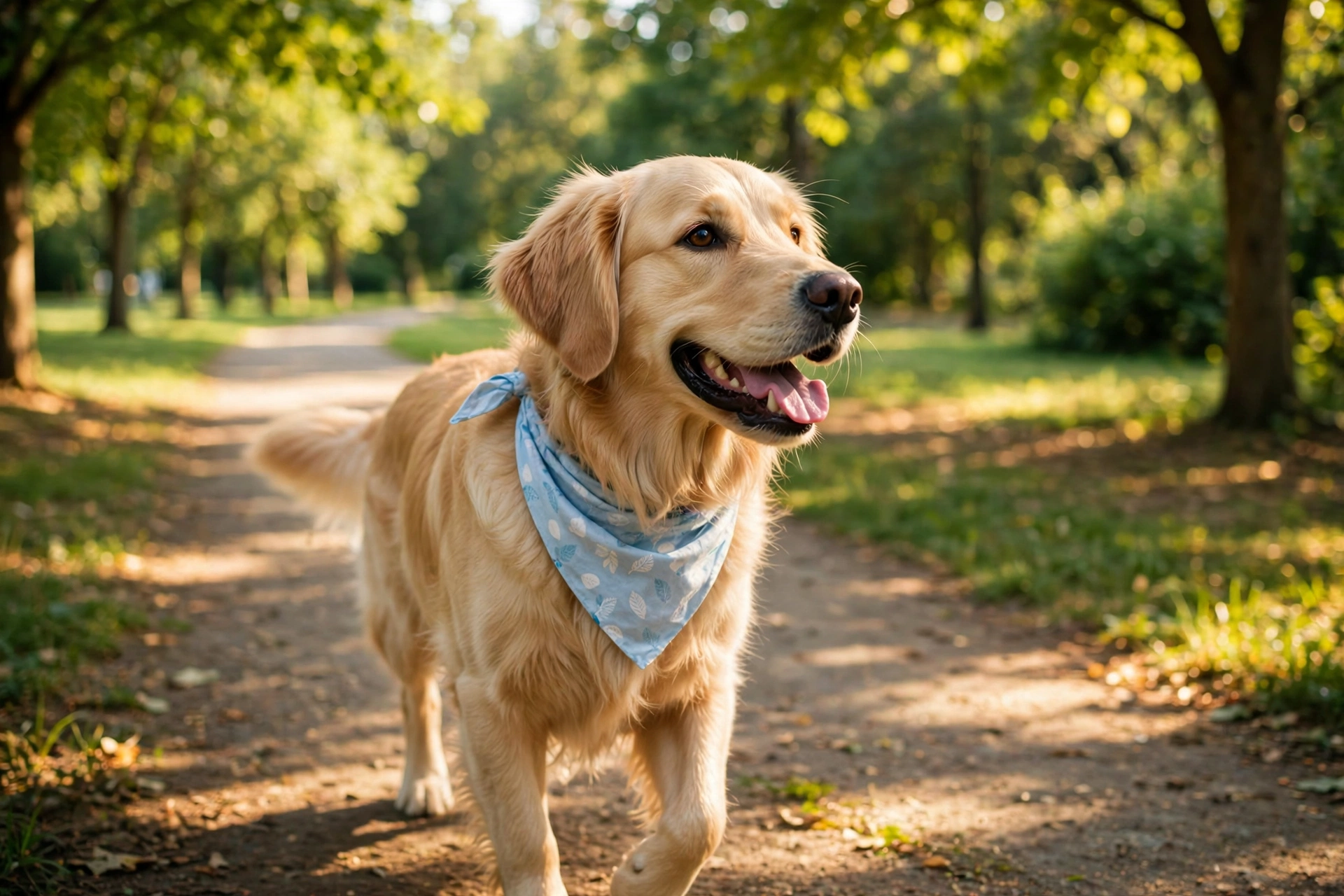
Quick verdict
A cooling bandana is the cheapest, lightest piece of summer gear you can buy for a dog — and, within its limits, it genuinely works. Soak it in cold water, tie it around your dog's neck, and evaporation pulls heat away from the blood vessels that run close to the surface there. On a dry, hot day, it can turn a walk your dog would have melted through into one they cope with.
The limits matter more than the benefits. A bandana only cools while water is evaporating from it, so it stops working in humid air, dries out in 30 to 60 minutes, and does nothing for a dog that is already overheating. It is a comfort extender for a healthy dog on a sensible walk — not heatstroke prevention, not a substitute for shade and water, and not a reason to stay out longer than you should.
How a cooling bandana actually works
The idea is the same physics as a wet T-shirt on a breeze: when water evaporates, it carries heat away with it. A soaked bandana sits against the neck, and as the water turns to vapour it draws heat from the skin underneath. The neck is a good spot for this — major blood vessels run close to the surface, and the area is usually less insulated by thick fur than the back or belly.
That is the whole mechanism: no gel, no battery, no magic fabric. Some bandanas hold more water than others, but they all live or die by one rule — no evaporation, no cooling. A bandana that is wet but not drying is just a wet cloth around your dog's neck. In dry heat with a breeze, the effect is noticeable: the fabric feels cold to the touch and your dog's panting often eases. In still, humid air, the water has nowhere to go and the bandana does very little. Movement helps, since a walking dog creates its own airflow. A dog lying still in a humid room gets almost nothing from one — our cooling mats vs. cooling vests guide covers the gear that works better for a resting dog.
The types you'll see in shops
Evaporative fabric bandanas are the most common: a lightweight mesh or chamois-style cloth you soak, wring out, and tie on. They cool for roughly half an hour to an hour, then need re-wetting from a water bottle. Cheap, simple, easy to wash — start here.
Polymer crystal bandanas contain small absorbent crystals sewn into the fabric. Soaked, the crystals swell into a gel that holds far more water than plain cloth, so the bandana stays cool for longer — often a couple of hours. The tradeoff is weight and bulk: fully swollen, it's noticeably heavier, and some dogs dislike the lumpy feel. It also needs a longer soak, often 15 to 30 minutes, before first use.
Ice-pack insert wraps have pockets for small reusable ice packs. They cool by direct contact rather than evaporation, so humidity doesn't matter — but the packs thaw in under an hour, and you need a freezer and a spare set for a long outing. A specialist option for dogs with a medical reason to stay cool.
A plain wet bandana deserves a mention too: any clean cotton bandana soaked in cold water does about 80% of what the specialist versions do for the first twenty minutes. Trying the idea for the first time? Start here before spending anything.
Where they hit their limit
The honest limit is humidity. Evaporative cooling depends on dry air accepting moisture, and on a muggy day the air is already full. If you live somewhere with humid summers, a bandana will disappoint you — the fabric stays wet, the dog stays hot, and the damp layer can even feel clammy. In dry heat, the same bandana is a different product entirely.
The second limit is time. Even the best evaporative bandana dries out, so plan on re-wetting every 30 to 60 minutes and carry the water to do it — a bottle you can squeeze over the fabric mid-walk, plus drinking water for the dog. If the bandana feels dry and warm to the touch, it has stopped cooling and is now just an extra layer.
The third limit is the dog. Bandanas help healthy dogs stay comfortable; they do not rescue a dog in trouble. Brachycephalic breeds like bulldogs, pugs, and French bulldogs overheat far faster than other dogs, and no accessory changes that — short walks, early mornings, and shade are the only real answers. The same goes for overweight dogs, very old dogs, and puppies. If your dog is panting hard, drooling, wobbling, or refusing to move, that is not a moment for a bandana: get indoors, offer water, and cool them with wet towels on the belly and paws. Our dog first-aid kit guide covers what to pack for summer walks, including the basics that matter when heat becomes an emergency.
Fitting and safety: getting it right
A bandana should sit snug against the neck — not tight, not loose. The two-finger test works here as it does for collars: you should be able to slide two fingers flat between the fabric and your dog's neck. Too tight and it restricts panting, the one thing a hot dog must be able to do freely. Too loose and it slides, bunches, or becomes something to chew. Tie the knot to the side, not under the chin, so it doesn't press on the throat when your dog pulls.
Never leave a bandana on an unsupervised dog: a loose tie is a snagging and choking hazard, and a determined chewer can swallow fabric or the crystals from a polymer bandana. Take it off indoors once it has dried out — a dry bandana is just an unnecessary layer. And if you use an ice-pack wrap, keep a thin fabric layer between the pack and the skin rather than pressing ice directly against it.
Washing matters too. A bandana that lives damp in a drawer grows mildew fast. Rinse it after every use, let it dry fully in the air, and wash it with your dog's other gear weekly.
Heat safety beyond the bandana
No accessory replaces the basics, and the basics are free. Walk early or late, when the sun is low and the pavement has cooled — press the back of your hand to the ground for seven seconds; if it's too hot for you, it's too hot for paws. Carry water and offer it often. Build in shade breaks on every summer route, and learn the early signs of heatstroke: heavy, rapid panting, thick drool, bright red gums, glazed eyes, wobbling, or vomiting. Those signs mean stop, shade, water, and a vet call — in that order.
Sun protection is part of the same picture: dogs with thin coats, pale skin, or pink noses can sunburn, and a bandana does nothing for an exposed belly or ear tips. Our dog sunscreen guide explains which products are dog-safe and where to apply them. And if your summer walks run into the evening, our LED collar guide covers night visibility.
What to look for before you buy
Measure your dog's neck before ordering — don't guess from weight, since breeds carry bulk differently — and check the size chart for the actual neck range. Look for lightweight mesh or chamois-style fabric, a tie or adjustable closure rather than a fixed loop, and light colours that reflect sun instead of absorbing it. A reflective trim is a bonus if you walk at dawn or dusk, and machine-washable is worth paying a little extra for.
Price is the good news: most evaporative bandanas are genuinely cheap, and the expensive ones are rarely better — you're usually paying for branding or a fancier pattern. Spend the savings on the things that matter more: a good water bottle for re-wetting and drinking, and a proper cooling vest if your dog does long summer outings. For longer walks, a vest covers far more of the body and stays effective longer — the same evaporative idea, scaled up.
Swamp Cooler Vest by Ruffwear
Best for: Dogs that overheat on walks and hikes, Active breeds in dry heat
- Three-layer construction: wicking outer layer, water-absorbing middle, cooling inner mesh per manufacturer specs
- UPF 50+ sun protection per manufacturer specs
- Side-release buckles and leash portal for harness compatibility per manufacturer specs
What we like
- Cools the dog while moving — the only option that works on walks
- Reflective trim and light colors reduce sun heat
- Stays in place well on active dogs
Tradeoffs
- Needs re-soaking every couple of hours in heat
- Less effective in very humid conditions where evaporation slows
Based on published specifications · Last checked 10/08/2026
PupFlask Travel Water Bottle by Tuff Pupper
Best for: Hikers and road-trippers
- 40 oz capacity with attached bowl tray per specs
- One-hand operation design
- Carabiner clip included
What we like
- Big capacity for long outings
- Unused water drains back — no waste
- Clips to a pack or belt
Tradeoffs
- Larger capacity models are bulky in a daypack
- Cap mechanism needs a rinse after muddy trails
Based on published specifications · Last checked 10/08/2026
FAQ
Can my dog wear a cooling bandana all day?
No. It's a walk accessory, not all-day clothing. Use it for the outing, take it off when you get home, and let it dry fully. A damp bandana left on a resting dog in humid air does nothing useful and can irritate the skin underneath.
How often do I need to re-wet it?
Every 30 to 60 minutes in dry heat, more often if it's very hot or windy. If the fabric feels dry or warm to the touch, it's done. Carrying a second, pre-soaked bandana in a sealed bag is a simple trick for longer walks.
Do cooling bandanas work in humid weather?
Barely. Evaporation is the mechanism, and humid air slows it to a crawl. In humid summers you'll get far more from shade, water, shorter walks, and a cooling mat at home than from any evaporative product. Ice-pack wraps are the one exception, since they cool by contact.
Bandana or cooling vest — which should I buy first?
The bandana, because it's cheap and tells you whether your dog tolerates evaporative gear at all. If your dog hates damp fabric around its neck, it will hate a full vest even more. If the bandana works and you want more coverage for longer outings, the vest is the upgrade — our cooling mats vs. vests guide compares the options.
The bottom line
A cooling bandana is a small, cheap, honest piece of gear: it makes a dry, hot walk noticeably more comfortable for about half an hour at a time, and it asks almost nothing of you or your dog. Its limits are real — humidity kills it, it dries out, and it never replaces shade, water, and good timing — but at its price, "helps a bit" is a fair deal. Soak it, tie it snug, carry water to re-wet it, and take it off when the walk is over. The rest of summer safety is free, and it matters more than anything you can buy.
More in Walk Gear
Dog First-Aid Kit Essentials: What to Pack for Walks and Hikes — and What to Leave Out
A palm-sized kit covers almost every walk injury: what to pack, how to treat cut paws, stings and ticks on the trail, and what to leave at home.
LED Dog Collars for Night Walks: Are They Safer Than Reflective Gear?
An LED collar makes your dog visible in total darkness from every direction — exactly where reflective gear fails. Battery types, fit, and the LED-plus-reflective setup compared.

Dog Halloween Costumes: Cute vs Safe — What to Check Before You Buy
A costume is fine fun for fifteen supervised minutes — if it passes the safety checklist. Fit, breathing, chewable parts, stress signs, and the night's bigger hazards.