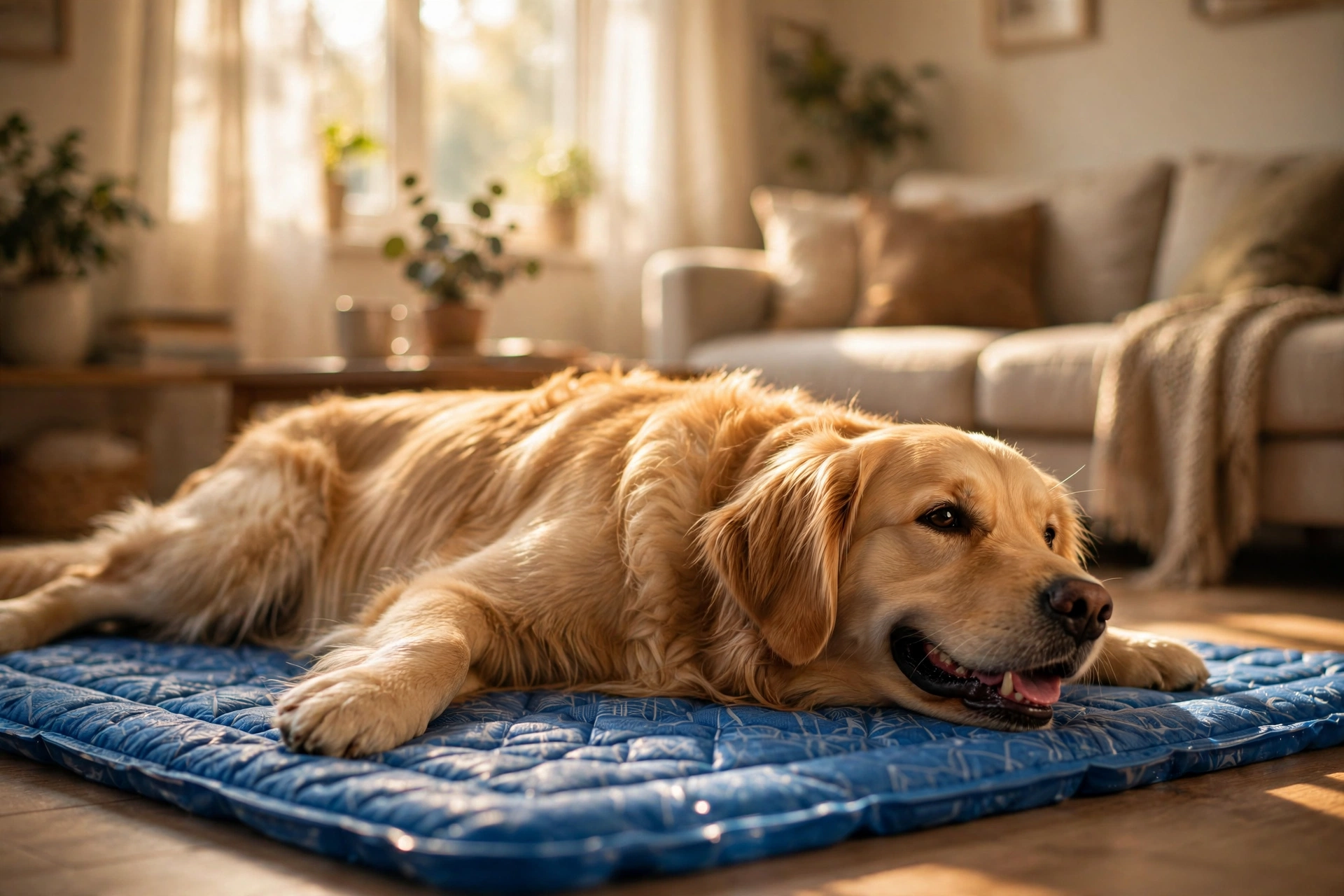
Quick verdict
If you want one honest answer: cooling mats are the better buy for most dogs, and cooling vests are the better buy for the rest of the time. A mat does its work while your dog rests — no fitting, no soaking, no cooperation required — which makes it the natural first choice for heat waves and panting dogs at home. A vest does its work while your dog moves: on walks, hikes, and training sessions where a mat is useless. The comparison isn't really mat or vest; it's stationary cooling versus mobile cooling. If your dog overheats outdoors and you're only buying one thing, buy for where the heat hits hardest.
The real-life scenario
It's mid-July, the kind of afternoon where the sidewalk radiates through your shoe soles. You cut the walk short, your golden retriever flops onto the cool tile of the kitchen, and fifteen minutes later she's still panting with that thin, fast rhythm that makes you hover. You check her gums, you offer water, she finally settles — but you're left thinking there has to be a better plan than "wait it out on the floor."
Meanwhile your neighbor's husky trots past in a damp-looking vest, tongue normal, tail up, looking like he's out for a pleasant stroll while yours melted after one block. Two products, two philosophies: one cools the dog who is already lying down, the other cools the dog who is still out in it. Summer forces you to answer the same question every heat wave — do you cool the resting spot, or cool the dog?
How it works
Cooling mats come in two main types. Pressure-activated gel mats (like the well-known Cool Pet Pad design) use a non-toxic gel that absorbs body heat on contact — lie down, and the surface feels noticeably cool under your dog, no water, freezing, or electricity required per the manufacturer. Water-filled beds (like the Cool Bed design) work on the same principle with water you fill at home, which generally holds a lower temperature for longer but weighs more and needs occasional refills.
Cooling vests work by evaporation. You soak the vest in cold water, wring it out, and put it on the dog; as the water evaporates it pulls heat away from the body — the same reason a wet T-shirt feels cold on a breeze. Designs like the Swamp Cooler style add layered fabric that wicks moisture outward while shielding the dog from direct sun. The effect lasts as long as the vest stays damp, typically a couple of hours on a walk, and you can re-wet it from a water bottle mid-hike.
The physics matters because it explains the split: mats cool by conduction (contact with a cooler surface), which only works when the dog stays put; vests cool by evaporation, which works in motion but stops the moment the fabric dries. Neither one replaces shade, water, or common sense — a dog left in a hot car is in danger regardless of gear, and brachycephalic breeds like bulldogs and pugs can overheat faster than either product can compensate for.
What to look for before you buy
For mats: size, surface type, and durability. The mat has to be big enough for your dog's full lying-down length — a mat your dog hangs off is a mat your dog won't use. Gel mats are lighter and travel-friendly; water-filled mats run cooler longer but are heavy once filled. The honest tradeoff nobody advertises: gel mats are puncture-prone, so if your dog digs or chews bedding, a water-filled or sturdier mat survives longer. Wipe-clean surfaces matter because a cooling mat becomes a favorite nap spot fast.
For vests: fit, coverage, and coverage that stays put. A vest that slides sideways is doing nothing for the chest and belly where cooling matters most. Look for an adjustable belly strap and a fit guide from the manufacturer — measure the girth behind the front legs, not just weight, because breeds distribute bulk differently. Lighter colors reflect more sun than dark ones, and a vest with a leash portal saves you from layering a harness on top awkwardly.
Realistic expectations for both. Neither product lowers core temperature the way shade and rest do. Think of them as comfort extenders: the vest turns a walk cut short at twenty minutes into a comfortable forty; the mat turns a restless panting session into an actual nap. If your dog has a heart condition or breathing trouble, check with your vet before relying on either — some dogs shouldn't be out in heat at all.
The combination play. Many owners in hot climates end up with both: the vest for the morning walk, the mat waiting at home. It's also worth thinking about the sleep setup itself — our orthopedic dog bed guide for seniors covers how joint support and cooling can overlap for older dogs, since many cooling mats double as thin beds.
Cool Pet Pad by Green Pet Shop
Best for: Dogs that overheat while resting at home, Owners who want zero-setup cooling
- Pressure-activated cooling gel — no water, freezing, or electricity needed per manufacturer specs
- Self-recharging: gel re-cools after brief non-use per manufacturer specs
- Wipe-clean surface; folds for travel per manufacturer specs
What we like
- Works the moment the dog lies down — nothing to soak or charge
- Lightweight and portable for travel
- Non-toxic gel per manufacturer specs
Tradeoffs
- Gel surface can be punctured by determined chewers
- Cools by contact only — no good for active outdoor use
Based on published specifications · Last checked 2026-10-08
Cool Bed III by K&H Pet Products
Best for: Hot climates where gel mats warm up too fast, Dogs that chew or dig bedding
- Water-filled core holds a lower temperature longer than gel per manufacturer specs
- Outer cover wicks moisture and resists punctures per manufacturer specs
- Can be topped up or emptied via fill cap per manufacturer specs
What we like
- Stays cooler longer than gel mats in sustained heat
- Sturdier against digging and chewing than thin gel pads
- No refrigeration or power required
Tradeoffs
- Heavy once filled — not a travel mat
- Needs occasional water top-ups
Based on published specifications · Last checked 2026-10-08
Swamp Cooler Vest by Ruffwear
Best for: Dogs that overheat on walks and hikes, Active breeds in dry heat
- Three-layer construction: wicking outer layer, water-absorbing middle, cooling inner mesh per manufacturer specs
- UPF 50+ sun protection per manufacturer specs
- Side-release buckles and leash portal for harness compatibility per manufacturer specs
What we like
- Cools the dog while moving — the only option that works on walks
- Reflective trim and light colors reduce sun heat
- Stays in place well on active dogs
Tradeoffs
- Needs re-soaking every couple of hours in heat
- Less effective in very humid conditions where evaporation slows
Based on published specifications · Last checked 2026-10-08
FAQ
Are cooling mats safe for puppies and chewers?
The gel inside most mats is non-toxic per the manufacturer, but "non-toxic" isn't the same as "fine to eat." If your dog chews bedding, supervise the first few uses and check the mat for punctures regularly. Determined chewers do better with a water-filled mat or simply a ceramic tile in the shade — indestructible and free.
How long does a cooling vest stay cool?
Plan on one to three hours depending on heat, humidity, and airflow, per how evaporative cooling works. In dry heat it performs best; in heavy humidity evaporation slows and so does the cooling. Re-soak from a water bottle to extend it — most designs are made to be re-wetted mid-walk.
Can my dog sleep on a cooling mat all night?
For healthy adult dogs, yes — the gel type self-regulates and won't overcool. Puppies and very small or elderly dogs are the exception: they lose heat faster, so offer the mat as an option beside a normal bed rather than the only surface, and watch the first few nights.
Do cooling vests replace shade and water breaks?
No, and treat any product that implies otherwise with suspicion. A vest extends comfortable outdoor time; it doesn't make 95°F (35°C) safe. Keep walks short in peak heat, carry water, and watch for heavy panting, drooling, or stumbling — the early signs of heatstroke need a vet, not gear.
Mat or vest for a dog that overheats indoors?
The mat, no contest. Vests are for the outdoors. If your dog pants through the night in a warm house, pair a cooling mat with better airflow — a fan at floor level — and if it's a senior, check our orthopedic bed guide for sleep setups that address heat and joints together.
The bottom line
Buy the mat if your dog overheats at rest — it's the lowest-effort, highest-reliability cooling you can give a dog at home. Buy the vest if your dog overheats in motion — it's the only thing in this category that cools a moving dog. In genuinely hot climates, owning both isn't extravagance; it's the difference between a dog that dreads summer and one that barely notices it.
More in Home & Sleep
Enzymatic Cleaners for Pet Stains and Odors
Urine odor that keeps coming back isn't a cleaning failure — it's chemistry. How enzymatic cleaners digest the residue regular cleaners leave behind, and how to apply them so they finish the job.
Dog Gates and Playpens: Creating Safe Home Zones
Pressure-mounted or hardware-mounted? Gate or playpen? How to divide your home into safe zones for a puppy — matching the barrier to the location, the athlete, and your daily routine.
Puppy Starter Kit: The Realistic Essentials Checklist
Less than the pet store suggests, more than 'just bring a collar.' The dozen items that actually matter in month one, and what to deliberately buy later.