
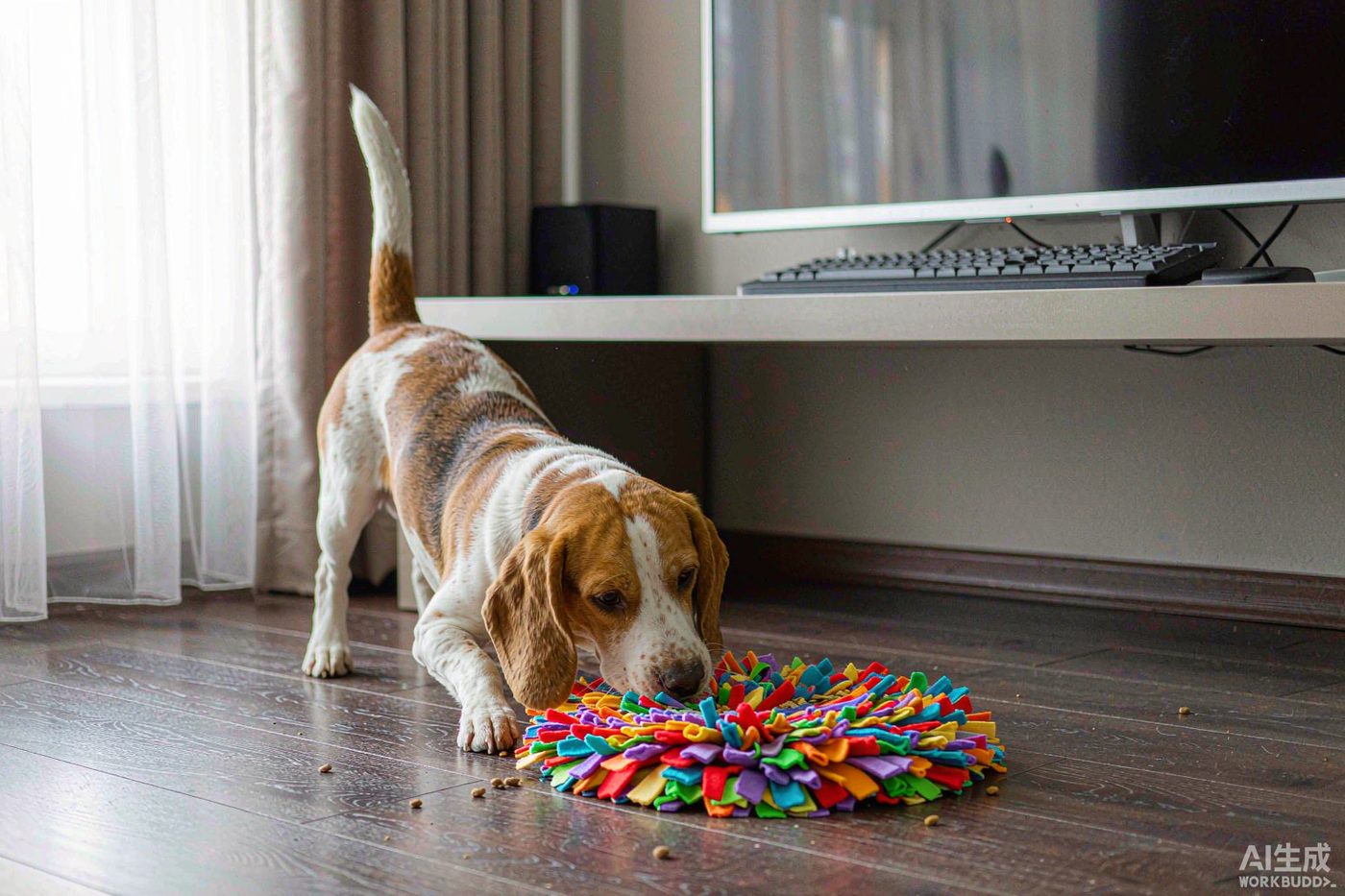
Of all the enrichment tools we’ve covered on DogeEmoji, the snuffle mat has the best effort-to-result ratio in existence: you scatter kibble into fabric strips, and ten minutes later the dog is as satisfied as after a long walk. It works because sniffing isn’t a filler activity for dogs — it’s how they read the world, and doing it hard is genuinely tiring.
Why sniffing tires dogs out
Scent work demands attention, decision-making, and nose-brain coordination — a canine equivalent of doing a crossword. Behaviorists consistently recommend scent-based enrichment for anxious and high-energy dogs precisely because it occupies the seeking system that would otherwise find its own entertainment (your baseboards). A common pattern owners report: fifteen minutes of snuffling produces a calmer dog than an hour of fetch. Physical exercise matters, but sniffing satisfies a different hunger.
How a snuffle mat works
A mat of fleece strips (usually 4–7 cm long) tied or sewn onto a sturdy rubber or fabric base. You bury kibble or treats between the strips; the dog noses through the fabric to find each piece. Difficulty scales automatically: shallow scatters are easy, deep-buried treats under folded flaps are hard. It’s a treat puzzle with zero moving parts and no plastic.
What to look for when buying
- Machine washable, actually. The mat gets covered in food and slobber. Look for explicit machine-wash instructions, and expect to wash it monthly at minimum (air dry). Mats with glued rather than tied/sewn strips shed strips in the wash — a recurring complaint in owner reviews.
- A rubber non-slip base. Otherwise the mat travels across hard floors like a shuffleboard disc while the dog roots through it.
- Strip density and length. Denser, longer strips = harder puzzle and more durable mat. Sparse short strips get solved in 90 seconds and pull out individually.
- Size vs. dog size. The mat should be big enough that the dog works it with its whole head, not one corner at a time. Small mats suit small dogs; a big dog on a small mat flips it.
- Fleece quality. Tight-weave fleece doesn’t fray into strings. Loose weaves shed — and loose string plus a dog is a swallow risk. Give any new mat a supervised first inspection: tug a few strips. Nothing should come loose.
Snuffle Mat (machine-washable, dense strips)
Tied or sewn strips (not glued), rubber non-slip base, tight-weave fleece, sized to your dog.
How to introduce it (five-minute setup)
- First session: scatter treats on top of the strips, not buried. The dog learns “this mat = food” before the puzzle starts.
- Second and third sessions: partially bury treats under strip edges.
- Then: full burial, fold flaps over, and let the real work begin.
- Always supervise the first week — some dogs decide the mat itself is a chew toy (if so, see our chew-proofing approach and pick the mat up between sessions until the novelty passes).
- Say a cue like “find it” as you set the mat down. Within a week, the cue itself becomes a rain-day energy valve.
Using it around a real schedule
- Breakfast or dinner in the mat a few times a week — it turns a 30-second bowl meal into ten minutes of work (see also slow feeder bowls for the speed-eating angle).
- The pre-meeting ritual: mat out with a handful of kibble at the start of a video call buys you quiet time more reliably than any toy.
- Rainy days and post-surgery rest: when physical exercise is off the table, snuffling is the best substitute in the toolkit.
Pros and cons
Why every owner we know owns one
- Genuinely tiring mental work with zero setup
- Cheap, no batteries, no plastic
- Slows fast eaters by design
- Calms anxious dogs (nose down = arousal down)
The small print
- Needs regular washing (food + slobber)
- Determined chewers can destroy strips
- Not for multi-dog houses without supervision — resource guarding risk
FAQ
Can I make one myself?
Yes — a rubber sink mat plus cut fleece strips tied through the holes is the classic DIY. It takes an evening and works well. Commercial mats win on strip density and wash durability.
Wet food in a snuffle mat?
Stick to dry. Wet food turns fleece into a bacteria experiment; for wet food use a lick mat or stuffed rubber toy instead.
How often should I wash it?
Monthly with normal use, sooner if it smells or after illness. Air dry fully — damp fleece in a corner gets musty fast.
Ten minutes of sniffing, one contentedly tired dog, and a machine-washable mat. It’s the closest thing to a cheat code in dog enrichment — see our beginner puzzle guide for the next level up.